Senin, 05 Maret 2012
Does Botox Change The Shrink?
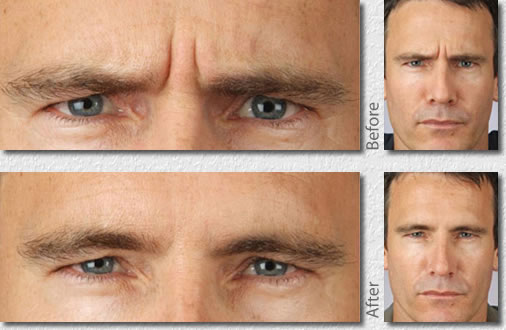
So I'm a little older than I used to be and recently when I look in the mirror, I've noticed some lines in my forehead when I make specific expressions. I'm not so sure I like them; when they show up in photos, they definitely make me look older. And yet, I know that these lines aren't just from aging, they are an occupational hazard. Part of attentive listening in psychotherapy involves using your face to convey, in non-verbal ways, obviously, feelings and expressions and interest and even questions. These are my quizzical lines. Really? Don't you think you're kidding yourself there? Give me a break. Not a word gets uttered, but oh so much gets communicated in silence, with the movement of just a few muscles. Yes, Clink, here and there I have a moment of silence. A short moment, but still. Wrinkles as an occupational hazard.
Every now and then I have the thought that maybe I should Botox those lines away, but my first thought is always, will it interfere with my work? Who am I as a healthy without the Quizzical Look? Will my patients relate to me differently? Will they have worse/different/better therapeutic outcomes if my facial muscles are paralyzed? Oh, and since they came from my work, can I tax deduct the cost of botox treatments?
No worries, I'll stay wrinkled....or quizzical....as long as Clink continues to be a nun look-a-like and Roy remains a geek.
Senin, 20 Februari 2012
Things I'm Thinking About This Holiday Weekend
The New York Times Op Ed editor doesn't seem to like stimulants these days. A few weeks back there was an article talking about a study showing that long-term stimulants aren't helpful, and today there is a piece by a writer who finds distraction helpful...told with some contempt towards his friend's son whom he calls Ritalin Boy. Steve over on Thought Broadcast has his own take on ADD meds.
What do you think: are stimulants helpful or not? I'll stand aside for this one.
Then there was the article about the business/computer whiz who put hundreds of thousands of dollars of his own money (and all his time) into a kidney transplant matchmaking service. If you need an uplifting story, this is an interesting one.
Over on KevinMD, Dr. George Lundberg is a bit skeptical of SAMHSA's new defining features for the Recovery Movement. I more or less agree, it feels like it's more about semantics (what does it mean to say recovery is "person-driven"? as opposed to?) than substance, and a lot of it seems to boil down to the idea that patients should be treated with respect and people with mental illnesses should work towards achieving their full potential. Those things I agree with, for everyone.
And finally, for the writers among us, Pete Earley has a Before You Quit Your Day Job post up on his blog. I'm still pondering the $80,000 advance. The Shrink Rappers need an agent, oh, but we do love our friends over at Johns Hopkins University Press.
And finally, for my friend ClinkShrink the Introvert, who wrote a review of a Quiet: The Power of Introverts in a World that Can't stop Talking (---huh, stop looking at me), here is an article called The Brainstorming Myth by Jonah Lehrer in The New Yorker.
Okay, lots of links. This is what I've been thinking about. Aside from that, I made a quick trip to NYC and had my photo taken with Cookie Monster in Times Square, and I loved Jersey Boys.
Jumat, 17 Juni 2011
Weiner Diagnosis?
Oh my, I thought. I read it twice. An internist is going to comment on Anthony Weiner's narcissism, motivations, sense of self, and contact with reality? Sounds like a shrinky thing to me, but the Goldwater Rule prohibits healthys from commenting on the mental state and diagnosis of someone they haven't personally examined. Does that mean it's okay for other specialists to talk about the mental state of someone they don't know? Hmmm... I guess we'll see what he has to say, but I'm not so sure about this.
Jumat, 04 Februari 2011
What Do You Think Of This Video Ad?
From yesterday's mail:
I work with FINS.com, a career resource site owned by The Wall Street Journal. We are launching a new national ad campaign starting this week. We produced a series of videos about failed job interviews and what “not to do” tips. The fourth video in the series called “Strengths” (at http://www.fins.com/Job-Interview-Tips) and is set to begin airing early next week. A couple of us over here enjoy Shrink Rap. We thought that because the video is related to psychiatry, that it would be really cool to get your feedback and other reader’s feedback on the video prior to air date.
Thanks for your time in advance.
----So I watched the video and I thought, "Hey no one ever asks me to go their job interviews!" I watched a few of them: they are cute, and make a quick point, but you know, there is one with the tip Leave your Pets at Home. It shows a guy on an interview with a half dozen sweet dogs and cats, and I did wonder, "Well what about the support duck?" The Silence Your Cell Phone flick was so outrageous, but I don't doubt it happens at all. And Proof Your Resume....well maybe she should have gone with the flow when the interviewer was so impressed with her 'passion for finance' and not said she meant it to read 'passion for her fiance!'
So what do you think of the Strengths video? Are they poking fun of patients and shrinks, or is this something that has really happened and is it a valid tip? Yeah, it pokes fun, but so do all the others. Does it annoy you? Does it increase stigma? Is it cute with a reasonable point to make about how not to advertise one's weaknesses during a job interview?
Well those Wall Street Journal affiiliated folks want your input. Go for it!
Minggu, 09 Januari 2011
The Year In Homicide
There has been a lot of stories in the news lately about homicides committed in hospitals. Just out of curiosity, I went to the Bureau of Labor Statistics web site and pulled some data from their Census of Fatal Occupational Injuries. It confirmed what I suspected, that homicides of workers in hospitals have increased at twice the rate as correctional facilities, where worker homicides have remained stable. Here's the graph I was able to make from the BLS data:
OK, I'm in a hurry and the graph is small and fuzzy. I'll try again later, but the upshot is that the red bars (hospital murders) are up to 6 and 7 homicides per year while the blue bars (correctional facility murders) have remained stable at about 3 per year. This is only for the employees who have been murdered, not all murder victims. When I get a chance I'll go to the Bureau of Justice Statistics and see if I can find data for all murder vicitms in hospitals versus correctional facilities, not just employee victims.
When we consider the cost and repercussions of increased hospital security, think about this trend. We people wonder if it's safe to be a forensic healthy in corrections, I will bring out these numbers. It does seem to be safer to work in prison than in a hospital.