Tampilkan postingan dengan label politics. Tampilkan semua postingan

Selasa, 16 Oktober 2012

One Dad's Perspective

Okay, while our presidential candidates are debating, I thought I would link to an article by a former state legislator.  In "How I Helped Create a Flawed Mental Health System That Failed Millions -- and My Son," Paul Gianfriddo talks about his decades-long attempts to help his ill son, a young man who sounds to have mental health and educational needs that couldn't be met by a system with limitations.

Gianfriddo writes:


The 1980s was the decade when many of the state’s large psychiatric hospitals were emptied. We had the right idea. After years of neglect, the hospitals’ programs and buildings were in decay. But we didn’t always understand what we were doing. In my new legislative role, I jumped at the opportunity to move people out of “those places.” Through my subcommittee, I initiated funding for community mental health and substance abuse treatment programs for adults, returned young people from institution-based “special school districts” to schools in their hometowns, and provided for care coordinators to help manage the transition of people back into the community. 

But we legislators in Connecticut and many other states made a series of critical misjudgments that have haunted us all ever since. 

First, we didn’t understand how poorly prepared the public school systems were to educate children with serious mental illnesses in regular schools and classrooms. Second, we didn’t adequately fund community agencies to meet the new demand for community mental health services—ultimately forcing our county jails to fill the void. And third, we didn’t realize how important it would be to create collaborations among educators, primary care clinicians, mental health professionals, social services providers, and even members of the criminal justice system, if people with serious mental illnesses were to have a reasonable chance of living successfully in the community. 

During the twenty-five years since, I’ve experienced firsthand the devastating consequences of these mistakes.

The story about his son is heart-breaking and there is no happy ending.  I'll leave you to read the whole article and see what you think.  And if you'd like to check it out, Mr. Gianfriddo blogs, often about mental health issues, at Our Health Policy Matters.

Rabu, 15 Februari 2012

Should State Legislators Determine Indications for Medical Treatment?

The FDA evaluates studies on medications and deems them safe enough to justify use.  They also determine the "indications" for using any particular medicine, and once that's done, physicians will often use a medication 'off label.'  That means that Medicine A was found to be safe (or relatively safe, because even over-the-counter meds can be fatal for the wrong person at the wrong time), and it works better than a placebo at treating Disease A, but some studies have found it useful for Disease B, but the FDA hasn't gotten to approving it for this yet, and perhaps never will, but docs use it for Disease B anyway.  This is very common with the SSRI's, where one has been approved for a condition, but maybe the patient isn't tolerating that one so well, so the doc uses another SSRI with a different side effect profile, even though that particular med has not been approved for that particular condition.  Just an FYI, the SSRI's are : Prozac Zoloft Paxil Luvox Celexa Lexapro.   


So the FDA says inhaled marijuana (as opposed to Marinol, a pill form of cannabis) has no medical uses and the discussion is ended.  It can't really be studied at this point, because it has no medical value so your local university can't grow or get any weed and do studies on it, because it has no medical value.  And the federal government says it's illegal.   I do believe that with 16 states disagreeing, that perhaps the FDA should reconsider this stance and repeat a study or two on inhaled cannabis for nausea induced by chemotherapy or anorexia in AIDS so that medical marijuana can be studied, monitored, grown in a pure regulated way, prescribed for a known and proven condition with some parameters like other medical interventions: 30 day supply, directions on how much and how often to smoke it (ah, the pharmacy could roll for you), reassessment so that if your doc decides to give it to you "off label" for your low back pain, and that pain is so much better but funny, you've stopped working, you lie on the couch all day playing Grand Theft Auto, and your life has virtually stopped, the doc can say, "Glad it's helped your pain, but it's put you into an apathetic, amotivational state and your life has now gone down the toilet, I'm stopping this so you can go back to work and pay the mortgage and feed those hungry children."  Or for us shrinks, "Funny, but you didn't have schizophrenia until you started smoking this stuff, let's stop it."  Obviously, if the person has become addicted (and yes, you can get addicted to weed), they'll get it illegally, but the same is true of benzos or opiates, and really medical marijuana just can't be any worse then the fiasco we've had in this country with oxycontin, especially when it gets mixed with a bit of also-legal Xanax and also-legal Vodka, and I can give you a long list of names of people who can no longer testify to this, famous and otherwise.  


So for the moment, the demand for legalized Medical Marijuana is left in the hands of our legislators.  Who better to determine medical indication, necessity, length of treatment, and methods of monitoring.  In Maryland, there was a study group led by the state's health secretary, Joshua Sharfstein.  The plan called for going slow, required training of docs to prescribe it, and required that it be distributed through academic centers.  Two legislators who are pushing bills to legalize medical marijuana called it Misguided and Heartless.


Delegate Glenn of Maryland has proposed House Bill 15, a Medical Marijuana Act.  It provides that marijuana could be used for a variety of conditions.  They include: 


(1) “DEBILITATING MEDICAL CONDITION” MEANS:
(I) A CHRONIC OR DEBILITATING DISEASE OR MEDICAL CONDITION OR ITS TREATMENT THAT PRODUCES ONE OR MORE OF THE FOLLOWING:
  1. CACHEXIA OR WASTING SYNDROME;
  2. SEVERE, DEBILITATING, OR CHRONIC PAIN;
  3. SEVERE NAUSEA;
4. SEIZURES, INCLUDING THOSE CHARACTERISTIC
OF EPILEPSY;
5. SEVERE AND PERSISTENT MUSCLE SPASMS, INCLUDING THOSE CHARACTERISTIC OF MULTIPLE SCLEROSIS OR CROHN’S
DISEASE;
  1. AGITATION OF ALZHEIMER’S DISEASE;
  2. ANXIETY; OR
  3. DEPRESSION; OR
(2)
VIRUS (HIV);
“DEBILITATING MEDICAL CONDITION” INCLUDES:
  1. (I)  CANCER;
  2. (II)  GLAUCOMA;
  3. (III)  POSITIVE STATUS FOR HUMAN IMMUNODEFICIENCY
  4. (IV)  ACQUIRED IMMUNE DEFICIENCY SYNDROME (AIDS);
  5. (V)  HEPATITIS C;
  6. (VI)  AMYOTROPHIC LATERAL SCLEROSIS;
  7. (VII)  NAIL PATELLA;
  8. (VIII)  POST–TRAUMATIC STRESS DISORDER;
  9. (IX)  BIPOLAR DISORDER; OR
  10. (X)  THE TREATMENT OF ANY OF THE ABOVE LISTED CONDITIONS. 


    On the positive side, the law does require that "compassion centers" to either grow or distribute marijuana be at least 500 feet from pre-existing schools.  Because children can't walk 600 feet?  

    I'm told this bill won't pass, but another one, with out the listed psychiatric indications for the use of medical marijuana, may well pass.  I might be more pro-MMJ if the stats didn't reveal that 2% of recipients in Colorado have cancer and AIDS, and that many people are prescribed marijuana by non-healthys for psychiatric reasons, including insomnia.  And if medical marijuana was distributed by a pharmacy with directions on how much and how often to use it.  The one-year toke your heart out cards with the boutique flavors all as part of "wellness" don't fly so well with me.  If people want marijuana to be legal, then legalize it, but this type of legislation puts physicians in the middle as an agent.  Really, if we were talking about people smoking a little during their cancer treatments, this just wouldn't be the issue that it is.

    Okay, so my questions for you:

    1) A person gets medical marijuana for back pain or anxiety or whatever.  He gets arrested.  Should it be continued in jail?  Prison not be such a bad experience if you get to be high the whole time?

    2) Shrink Rap readers don't really like uninformed consent with meds.  How do we feel about giving it to agitated Alzheimers patients and how would that work?  Can you smoke in nursing homes?  Do they have to taken outside in restraints?  Agitation is not usually associated with early Alzheimers.

    3) Do we think it's just a little weird that a state legislator is making laws listing which medical indications a drug should be used for?  I must have missed those lectures in residency where pot is the treatment for depression, etc.   Can legislators also decide that methotrexate should be legal for the flu?  I sort of don't get it.  

    Okay, my rant for the day.


Selasa, 20 Desember 2011

Does Mental Illness Make People Better Leaders?


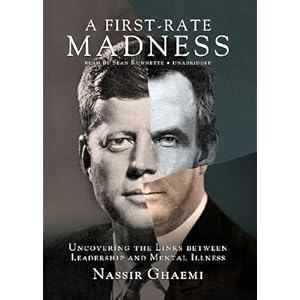
We've talked before about whether people with mental illnesses can be politicians (or pilots, or doctors).  Today, on Midday with Dan Rodricks on WYPR, healthy Nassir Ghaemi, author of A First-Rate Madness: Uncovering the Links Between Leadership and Mental Illness makes the case that in good times, we need sane and stable leaders, but that in difficult times, "insanity produces good results" and that in hard times those with mental illness are better leaders.  He talks about how mood disorders lead people to be more realistic, empathetic, resilient, and creative.  Want to hear more?  Click HERE to listen.


Kind of nice to hear a positive take on psychiatric disorders for a change.  Tell me what you think.

Minggu, 13 November 2011

Guest Blogger Dr. Jesse Hellman on The Penn State Matter


The news media has published numerous pieces exploring various aspects of what happened at Penn State. The sports culture, the prestige of the program, the money it brought into the university, the parallels with the Catholic Church, and so on. What kept action from being taken by administrators after an employee allegedly witnessed a violent crime? What kept that employee from stopping a violent act? What kept him from taking further action later?

The media has looked at various aspects of these questions, but two aspects have received little attention: Is there a difference between the way men and women react to these events, and are there factors that actually inhibit men from taking action in these circumstances?

Here is a "thought experiment:"  What would happen if the alleged crime were different-- if, for example,  a man had walked in on someone violently raping a ten year old female child? Would he have reacted the same, observing but not interfering, reporting it up the line, but not taking subsequent action? What would have happened if one of the administrators who learned of this had been a woman? My thesis is that it would have been very different if it had been a little girl, and that women involved as administrators would have been far less likely to ascribe this to "horse play," look the other way, and remain passive after reporting it up the line to superiors.

A man coming across a heterosexual rape, whether of an adult or a child, would know immediately that this is a terrible crime and would have immediately stopped it. It would be clear that the police should be involved. I wonder whether the homosexual act, even with a child, arouses feelings in men that actually inhibit action, that make it easier to turn away and rationalize not taking action. It is something that is harder to confront, to even think about. To the psyche it is perhaps the most forbidden of crimes, worse than incest.

Again, the purpose of this post is to discuss the general principles, not the individual actions at Penn State, of this subject. What are the Psychological Factors that inhibit Action when Evil is
Encountered?

Jumat, 17 Juni 2011

Weiner Diagnosis?

 
In Shrink Rapper world, we get a lot of email from publicists about books, TV spots, upcoming events.  This was in my spam box today:


Rep Anthony Weiner is expected to resign today after weeks of scandal surrounding his lewd text messages, tweets and photos.  Even in his tearful media conference, Weiner could not explain why he participated in such behavior.  According to NYU Medical Professor and Internist, Dr. Marc Siegel, the congressman’s behavior is systemic of a larger psychological problem, which must be addressed before fixing the addiction to online sexual activities.  
 
Dr. Siegel says, “This seems to be an example of extreme narcissism, inflated self image, depersonalization, loss of contact with reality, addiction, and the power of the Internet as a medium (like the Wizard of Oz you feel you are hiding behind the curtain)”.
 
To discuss the dangers of addiction and steps to overcome the serious illness, Dr. Siegel is available to offer is medical knowledge.  As a medical practitioner and FOX’s House Doctor, Dr. Siegel has spent years diagnosing and treating people in the national media spotlight.
 
If you are interested in speaking with Dr. Siegel, please contact me at .
 
Best,
Rena  
 
Rena Resnick

5W Public Relations

Oh my, I thought.  I read it twice. An internist is going to comment on Anthony Weiner's narcissism, motivations, sense of self, and contact with reality?   Sounds like a shrinky thing to me, but the Goldwater Rule prohibits healthys from commenting on the mental state and diagnosis of someone they haven't personally examined.  Does that mean it's okay for other specialists to talk about the mental state of someone they don't know?  Hmmm...   I guess we'll see what he has to say, but I'm not so sure about this.

Sabtu, 12 Maret 2011

The Gulag


Dinah is away this week so Roy and I are filling in. Here's a quick blog post (more to come). I stumbled over the Center for History and New Media web site this morning and found a video tour of an old Soviet gulag. In addition to the video, there's an accompanying audio tour (in Russian, with an English text translation). The camp is better than most, from what I gathered from the description, because it eventually housed formerly high-ranking prisoners. The thing that struck me most was this comment by the tour guide, about transfers out of the gulag to other facilities:

"If one could leave a camp or a jail, a mental institution meant a life sentence, because the effect of mind-altering drugs could not be reversed."
I wonder how many tourists have gone away from that tour thinking that healthys are equivalent to political persecutors. I've seen this attitude about psychiatric medications reflected in some legal opinions here in the United States as well, thankfully in cases a couple decades old, but present nonetheless---the idea that psychiatric medications are "mind-altering" rather than "mind-correcting."

Of course, there are people who have been hurt by psychiatric medications or who feel that they have been permanently damaged by them and I'm not dismissing or ignoring those experiences. I was just struck by the international nature of the stigma about meds.

Senin, 27 Agustus 2007

Manto vs. Joburg Gen

It has just been announced that the name of the Johannesburg General Hospital will be changed. From 1 September 2007 it will officially be known as the Manto Tshabalala-Msimang Pub & Grill.

Jumat, 23 Februari 2007

Smart Card system for Johannesburg hospitals...

HERE's a story. After all the debate around the possibility of using Ubuntu to roll out a cheap technology infrastructure to aid SA hospitals - it seems like someone took notice. Whether the Premier, Mr Mbhazima Shilowa (who looks absolutely DASHING in his jazz hat) reads All Scrubbed Up or not is another question. But hark the sounds of technology actually helping the patient situation.

Reported in the Citizen recently...

Shilowa also announced that long queues at provincial hospitals and clinics could soon be a thing of the past, should the government’s smart-card plan materialise.

In his State of the Province address he painted a picture of a paperless information system that would ensure speedy access to healthcare in all communities, especially for chronically ill patients.

He said the province would develop a computerised card system so patients would just have to “swipe” their cards when rushed into hospital for medical emergencies or when collecting medicines.

“This system will prevent long queues at dispensaries as pharmacists can immediately begin to package a patient’s medicinal supply without having to wait for long. The card system will also help doctors identify the patients’ previous treatment and prescribed medication. The doctor will in turn be able to speedily diagnose patients.”

Wow. That's thinking. The DA (our opposition party for international readers) had the customary negative things to say.

DA health spokesman Jack Bloom said the computerised plan for hospitals had been promised before.

Ah, what can ya do. Still, it remains one of the biggest problems - sharing information between the clinics and the hospitals. Not only in Johannesburg - but across the entire country.

Gotta wonder whether a fat cat government buddy is going to get the contract - or whether they'll have the nouse to farm it out to a low cost Linux collective. I can think of a few. If you're out there - here's a business pitch waiting to happen!

Kamis, 22 Februari 2007

Manto, our unhealthy minister...

It started a couple of days ago, as reported on IOL.

Outshone by colleagues who were brimming with good health at a cabinet cluster briefing in Cape Town on Thursday, Health Minister Dr Manto Tshabalala-Msimang became an object of pity and embarrassment.

And continued yesterday as reports flooded the media of the honorable Tshabalala-Msimang descending onto a ventilator at Joburg General private section.

Tshabalala-Msimang's health has been under the microscope since she returned to duty earlier this year - after a long illness.

She was admitted to the same hospital last year for several weeks suffering from a lung infection.

Her spokesman, Sibani Mngadi, confirmed she was being treated for severe anaemia and residual pleural effusion (fluid in the lining of the lungs).

Now, we would never wish this on anyone. Even though she's done some pretty pathetic things - health is health. And, somewhere deep inside, our beloved Manto understands some of the primary care issues facing this country.

Get better Sisi.

Senin, 23 Oktober 2006

The Good Side of Manto?

So, people are always bashing on our Minister of Health... including us on this blog, I suppose. But perhaps we should take a tiny step back, not slip on the magic condiments and have a look where Manto has actually done some good.

For instance, when you're enjoying your next smoke-free dinner, courtesy of the glass cage that smokers are now confined to... Who do you have to thank? Manto!

Did you also know? Our friend Manto is following through quite nicely on the process started by Zuma (not the showering one) to implement more Primary and Secondary level care in the country. Now, although that means less money pumped into ICU's, specialised surgery and specialised skills development - it does mean more access to primary medicines, increased immunisation and better preventative care. Small steps, but certainly the right direction.

So, there's some Prozac at the end of the rainbow then?

PS. Manto is still a complete idiot when it comes to HIV. The country despairs!

What happened to firing Manto!?


While she remains in the news, what has happened to that wonderful collection of wit, anger and HIV curing fruit? We lament the loss of www.firemanto.co.za.

Why? Anyone know what's going on?