Today on our local public radio station I heard an interview with Tonier Cain, a team leader for the National Center for Trauma Informed Care. Ms. Cain is a renown speaker who has appeared at multiple national venues to talk about her horrific childhood history of sexual and physical abuse, multiple adult arrests, history of prostitution and drug abuse, and incarceration in our own Maryland prison system. Her story is remarkable for her 180 degree transformation to become an accomplished organizer and advocate. She has repeated her narrative many times online, on the radio, and even in local theater. She frequently speaks to women prisoners to talk about the importance of trauma recovery therapy.
I was familiar with her story because the state of Maryland passed a law last year which mandated that anyone working in a state facility must be given training in trauma-informed care. I went through this training myself where I saw a shortened version of the documentary "Healing Neen," about Ms. Cain. Following the presentation the instructor asked what we thought about the film. Everyone in the room thought that it was wonderful, that Ms. Cain's story was amazing, that the trauma recovery treatment she had had was miraculous.
"Isn't it amazing how she has overcome her trauma?" the instructor asked.
I should have kept my mouth shut. I really should have.
But I couldn't help myself.
"But she hasn't recovered!" I blurted out. "She just reshaped it. She has recreated her personal and professional identity around her trauma narrative." And that's true---she is now a professional trauma victim/survivor. How is this overcoming her past? How is this recovery?
The room fell silent. People looked at me, a bit aghast and shocked. Some people tried to explain: "Well, you don't ever really COMPLETELY overcome the past, you just learn to live with it."
Well OK, that sounded reasonable. But wasn't the point of the trauma recovery movement that you actually are supposed to recover? That at some point, you stop being a patient? I mean, when I treat someone my goal is complete recovery----zero symptoms----that's what I call recovery. My goal is to free someone from being my patient, as much as possible. Isn't that the goal of the trauma-recovery movement?
Maybe I just was uninformed. Maybe I needed to read more about it.
I did a PubMed search using the terms "outcome" and "trauma-informed care." This search produced all of four articles. One focussed solely on trauma-informed interventions to reduce seclusion and restraints in the hospital. Another paper discussed the dirth of outcome-based evidence for trauma informed care for people with schizophrenia. There were no controlled trials, nothing in the way of any standard study of anything related to trauma informed care.
Yet education about this recovery movement and treatment approach is being mandated by our state government. There's something seriously wrong here. An intervention with no evidence base is being required and weighed on the same level as a requirement for CPR certification.
The trauma recovery and prevention movement also has moved into the domain of disaster psychiatry. This is the idea that prompt mental health intervention can prevent longterm psychiatric complications for people who experience traumatic events. I've written about this before on the blog in my posts "I Don't Need to Talk" and "I Still Don't Need to Talk", including a review of studies to suggest that for some people these interventions may actually be harmful. In his Mental Illness Policy blog, DJ Jaffe expressed similar concerns in his post "NYS Office of Mental Health: Wrong Response to Hurricane Sandy," where he discussed the diversion of mental health workers to crisis counseling and away from services for the seriously mentally ill.
Government money for mental health services is limited, and should be directed toward people with serious mental illnesses and evidence based practices.
Tampilkan postingan dengan label mental health. Tampilkan semua postingan
Sabtu, 03 November 2012
Selasa, 16 Oktober 2012
One Dad's Perspective
Okay, while our presidential candidates are debating, I thought I would link to an article by a former state legislator. In "How I Helped Create a Flawed Mental Health System That Failed Millions -- and My Son," Paul Gianfriddo talks about his decades-long attempts to help his ill son, a young man who sounds to have mental health and educational needs that couldn't be met by a system with limitations.
Gianfriddo writes:
Gianfriddo writes:
The 1980s was the decade when many of the state’s large psychiatric hospitals were emptied. We had the right idea. After years of neglect, the hospitals’ programs and buildings were in decay. But we didn’t always understand what we were doing. In my new legislative role, I jumped at the opportunity to move people out of “those places.” Through my subcommittee, I initiated funding for community mental health and substance abuse treatment programs for adults, returned young people from institution-based “special school districts” to schools in their hometowns, and provided for care coordinators to help manage the transition of people back into the community.
But we legislators in Connecticut and many other states made a series of critical misjudgments that have haunted us all ever since.
First, we didn’t understand how poorly prepared the public school systems were to educate children with serious mental illnesses in regular schools and classrooms. Second, we didn’t adequately fund community agencies to meet the new demand for community mental health services—ultimately forcing our county jails to fill the void. And third, we didn’t realize how important it would be to create collaborations among educators, primary care clinicians, mental health professionals, social services providers, and even members of the criminal justice system, if people with serious mental illnesses were to have a reasonable chance of living successfully in the community.
During the twenty-five years since, I’ve experienced firsthand the devastating consequences of these mistakes.
The story about his son is heart-breaking and there is no happy ending. I'll leave you to read the whole article and see what you think. And if you'd like to check it out, Mr. Gianfriddo blogs, often about mental health issues, at Our Health Policy Matters.
Selasa, 18 September 2012
Why Psychiatric Patients Die Younger
If you're reading this for the answer, you can stop now. I don't know why psychiatric patients die younger than people who do not have psychiatric disorders. I think that fact only applies to those with chronic psychiatric illnesses, not to someone who has had a single episode of depression or anxiety. What qualifies as a chronic mental illness? I'm not sure -- but certainly if you get on-going disability (SSDI) benefits because of your psychiatric disorder, or if you live with a careprovider and attend a long-term psychosocial rehabilitation program for years, or have resided in a state hospital for years.
How much less time do psychiatric patients live? The numbers vary from 8 years to 25 years, though I have hard time believing that the average lifespan of a psychiatric patient is only a little over 50. I have had a few psychiatric patients who have died young, but none under age 50.
So, if we start from the premise that psychiatric patients die younger than people without chronic and persistent mental illnesses, then why? I'll throw out some ideas. None of them are the right answer because there is no right answer, just my thoughts on some possible contributing factors.
- Poor coordination of care: psychiatric patients may be less likely to make appointments, coordinate their care, and may receive medical treatment of their conditions at a substandard rate. (Roy likes this one, I bet)
- Psychiatric patients smoke cigarettes at rates that are higher than the general public.
- Psychiatric medications predispose people to weight gain and metabolic syndromes that may precipitate diabetes and heart disease.
- Psychiatric patients have high co-morbidity with substance abuse disorders and substance abusers die young for many reasons.
- Psychiatric patients have higher rates of suicide and suicide is common cause of death among young people.
- People with psychiatric disorders may not be evaluated as carefully as people without such disorders when they present to a medical professional with problems. The medical professionals may be too quick to attribute problems to anxiety or depression or psychiatric concerns.
- Certain psychiatric conditions may predispose people to behaviors that are not good for them.
- Certain psychiatric conditions may predispose people to have less interest in investing energy in the caring for themselves or making lifestyle decisions that favor good health.
- Chronic mental illness is associated with poverty and this is associated with obesity, and as well as a lower likelihood of investing in more expensive and healthier food choices, gym memberships, and a full range of medical care.
- Patients with psychiatric disorders may have fewer close relationships and family members often cajole their relatives to take care of themselves, pursue medical care, and provide a reason to live.
Selasa, 31 Juli 2012
Diane Rehm Show: Mental Health Under the Affordable Care Act
I was a guest on today's Diane Rehm Show on National Public Radio, along with Rachel Garfield from the Kaiser Family Foundation, Pamela Hyde from SAMHSA, and Richard Frank, the Harvard health economist.
The topic was about the Accountable Care Act (ACA) and its potential impact on mental health and addiction services.
They already have the recording up, as well as a transcript.
The topic was about the Accountable Care Act (ACA) and its potential impact on mental health and addiction services.
They already have the recording up, as well as a transcript.
Senin, 20 Februari 2012
Things I'm Thinking About This Holiday Weekend
Happy Presidents' Day. I probably have 50 blog posts floating around in my head, but I thought I'd share with you some of the stuff I've been reading on line lately.
The New York Times Op Ed editor doesn't seem to like stimulants these days. A few weeks back there was an article talking about a study showing that long-term stimulants aren't helpful, and today there is a piece by a writer who finds distraction helpful...told with some contempt towards his friend's son whom he calls Ritalin Boy. Steve over on Thought Broadcast has his own take on ADD meds.
What do you think: are stimulants helpful or not? I'll stand aside for this one.
Then there was the article about the business/computer whiz who put hundreds of thousands of dollars of his own money (and all his time) into a kidney transplant matchmaking service. If you need an uplifting story, this is an interesting one.
Over on KevinMD, Dr. George Lundberg is a bit skeptical of SAMHSA's new defining features for the Recovery Movement. I more or less agree, it feels like it's more about semantics (what does it mean to say recovery is "person-driven"? as opposed to?) than substance, and a lot of it seems to boil down to the idea that patients should be treated with respect and people with mental illnesses should work towards achieving their full potential. Those things I agree with, for everyone.
And finally, for the writers among us, Pete Earley has a Before You Quit Your Day Job post up on his blog. I'm still pondering the $80,000 advance. The Shrink Rappers need an agent, oh, but we do love our friends over at Johns Hopkins University Press.
And finally, for my friend ClinkShrink the Introvert, who wrote a review of a Quiet: The Power of Introverts in a World that Can't stop Talking (---huh, stop looking at me), here is an article called The Brainstorming Myth by Jonah Lehrer in The New Yorker.
Okay, lots of links. This is what I've been thinking about. Aside from that, I made a quick trip to NYC and had my photo taken with Cookie Monster in Times Square, and I loved Jersey Boys.
The New York Times Op Ed editor doesn't seem to like stimulants these days. A few weeks back there was an article talking about a study showing that long-term stimulants aren't helpful, and today there is a piece by a writer who finds distraction helpful...told with some contempt towards his friend's son whom he calls Ritalin Boy. Steve over on Thought Broadcast has his own take on ADD meds.
What do you think: are stimulants helpful or not? I'll stand aside for this one.
Then there was the article about the business/computer whiz who put hundreds of thousands of dollars of his own money (and all his time) into a kidney transplant matchmaking service. If you need an uplifting story, this is an interesting one.
Over on KevinMD, Dr. George Lundberg is a bit skeptical of SAMHSA's new defining features for the Recovery Movement. I more or less agree, it feels like it's more about semantics (what does it mean to say recovery is "person-driven"? as opposed to?) than substance, and a lot of it seems to boil down to the idea that patients should be treated with respect and people with mental illnesses should work towards achieving their full potential. Those things I agree with, for everyone.
And finally, for the writers among us, Pete Earley has a Before You Quit Your Day Job post up on his blog. I'm still pondering the $80,000 advance. The Shrink Rappers need an agent, oh, but we do love our friends over at Johns Hopkins University Press.
And finally, for my friend ClinkShrink the Introvert, who wrote a review of a Quiet: The Power of Introverts in a World that Can't stop Talking (---huh, stop looking at me), here is an article called The Brainstorming Myth by Jonah Lehrer in The New Yorker.
Okay, lots of links. This is what I've been thinking about. Aside from that, I made a quick trip to NYC and had my photo taken with Cookie Monster in Times Square, and I loved Jersey Boys.
Sabtu, 24 Desember 2011
NYT: Story about Antonio Lambert and Peer Counseling
This is a great story about turning around ones life with addiction and mental illness, giving back by training others to do peer counseling, which is such a proven strategy that Medicaid will pay for it.
[posted via email]
From The New York Times:
LIVES RESTORED : After Drugs and Dark Times, Helping Others to Stand Back Up
The mental health care system has long made use of former patients as counselors, like Antonio Lambert, an ex-convict turned mental health educator in Delaware.
http://nyti.ms/uxDM2Y
[posted via email]
From The New York Times:
LIVES RESTORED : After Drugs and Dark Times, Helping Others to Stand Back Up
The mental health care system has long made use of former patients as counselors, like Antonio Lambert, an ex-convict turned mental health educator in Delaware.
http://nyti.ms/uxDM2Y
Senin, 16 Mei 2011
Guest Post from Eric Stevenson: Caring for a chronic illness patient: A difficulty on its own
This Guest Post is from Eric Stevenson, a health and safety advocate who resides in the South Eastern US.
Having a chronic illness can be extremely tough, not only for the patient themselves but also for those who care for them. The process of loving and supporting someone with a chronic illness can be very difficult and challenging. Many times caregivers don’t want to speak up about their own stress because they may feel guilty or that it doesn’t matter as much than the patient’s problems. Luckily, there are a few ways to be prepared and help in the difficult situation of caring for a person with a chronic illness.
There’s a great amount of social factors and possible coping strategies involved with care giving, as some things can influence stress levels in a positive or negative direction. Financial instability can cause major stress and mental issues for caregivers. In many times a chronic illness can lead to major financial problems as hospital bills continue to stack up. Financial factors can influence the mental state of caregivers in either direction. With more financial support, caregivers are often able to delegate some of their responsibilities, thus lowering stress and improving mental health.
Social support also plays a huge role in the process of caring for a chronic illness patient. The help of family, friends, or even neighbors can play both a positive and negative part in the mental state. Not allowing for any support for the patient can often cause problems, but so can minimal support for yourself or a care giver. The stress and difficulty of taking care of someone with a chronic illness can be a major burden. Not having anyone to talk to or vent is often a major cursor to stress.
Many people deal with side effects of coping strategies. Some may take to avoidance, but in many cases that will lead to further health problems. Avoidance as a coping strategy has been known to bring on many cases of depression. Many caregivers with low self esteem will use emotionally charged coping strategies, while those with high self esteem may turn to task centered coping methods. In the end, research has shown a large connection in self esteem and depression within caregivers.
Factors such as the type of illness and location will also play a large part in the process. Some diseases like mesothelioma (a cancer forming from asbestos exposure) will have a severely low life expectancy. When compared to a patient that may be expected to live many years longer, the care giving situation will be extremely different.
In the end, there are certainly a few factors that will play a large part in the role of a caregiver for those with chronic illnesses. The value of a support system and being educated on the disease will remain important. Caring can end up being extremely difficult and stressful, thus caregivers should also be looked out for in the future.
Minggu, 06 Februari 2011
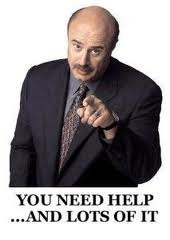
You Need Help!
Sometimes in my real life it becomes obvious that a friend or acquaintance is having a problem. Either they are wearing obvious signs of mental illness or they just show signs of being 'stuck' in life or, worse, of moving backwards. Often they don't see it. I suppose there is the outsider's vantage point of making a judgment that may reflect my own value system and not their reality: to me, I may see someone who has family and job and connections who sees leaving those things as a healthy escape and their withdrawal as a good kind of comfort with keeping their own company. Usually these aren't my close friends, but what do you do when you notice that someone in your life is changing and might possibly benefit from help?
In general, I've found that "You need help" is not helpful. People hear this as an insult, not as a kind suggestion from a concerned friend. And from a healthy friend it may be worse and easier to blow off---shrinks think everyone's crazy, they push drugs, they think everyone needs therapy, they see the world in a skewed way (at least this is how the commercial runs).
So I wondered: how do people let their friends know they need help in a way that inspires them to get it in the absence of a crisis? If you're in treatment because someone else suggested it, what enabled you to hear the suggestion without being wounded or insulted?
Rabu, 03 November 2010
Repealed: Kansas voters repeal law that could block people with mental illness from right to vote
Back in the 1970s, Kansas passed a law that could prevent people with mental illness from voting. The law was never used, but advocates were successful in getting an amendment passed that revoked that law.
This law was passed at a time when stigma against mental illness was much higher than now. I'm guessing it was presumed that folks with a mental illness could not reason enough to exercise an informed vote, which is not true, of course. If 1outta5 have a psychiatric illness, including anxiety, depression, and substance abuse, then there could have been a huge swath of disenfranchised voters.
And there already exists, to a degree, a basic cognitive test for voting -- navigating the whole ballot process. In Maryland, ours was electronic and no harder to use than an iPad, but I could still imaging some with severe dementia unable to navigate the system. But there should never be a cognitive bar one must pass to vote; the challenge would be where you draw the line.
This law was passed at a time when stigma against mental illness was much higher than now. I'm guessing it was presumed that folks with a mental illness could not reason enough to exercise an informed vote, which is not true, of course. If 1outta5 have a psychiatric illness, including anxiety, depression, and substance abuse, then there could have been a huge swath of disenfranchised voters.
And there already exists, to a degree, a basic cognitive test for voting -- navigating the whole ballot process. In Maryland, ours was electronic and no harder to use than an iPad, but I could still imaging some with severe dementia unable to navigate the system. But there should never be a cognitive bar one must pass to vote; the challenge would be where you draw the line.
Rabu, 13 Oktober 2010
What Makes Mental Illness Bad?
So why is it that some people have a psychiatric disorder and they bounce back and it's not a big deal, while others struggle terribly? For the unlucky ones, mental illness defines them.
Here are some factors that affect how much impact psychiatric illness has in a person's life:
(Note to Roy: did I get the effect/affect thing right here?)
1) The severity of the symptoms.
Any way you dice it, mild-to-moderate anxiety can often be hidden and isn't as disruptive as an episode of psychosis with hallucinations and paranoid delusions.
Just to give an example.
2) The duration of the episodes.
So a chronic depression or severe obsessive compulsive disorder may be more disabling than a brief episode of psychosis.
3) The form of the symptoms.
Some symptoms are intrinsically more public than others, or more difficult to bounce back from. In terms of "Can I be a doctor if I have bipolar disorder?," one episode of walking around the hospital naked may be all it takes to get sent home.
Form and severity of symptoms, and the duration of the episodes, are likely to be intrinsic to the disease and not something the individual controls.
4) How responsive the illness is to treatments.
Some people have very severe symptoms that are very responsive to treatment.
5) External support systems: access to good care, chicken soup, and TLC. Job flexibility may enable some people to quietly take time off when the going gets rough. Understanding friends & family-- these are all good things.
6) Individual personality features that support good coping. This is vague and I just made it up, but it's the best I can do--- maybe 'resilience' is another term for it.
7) Individual special features which help a person compensate. So being extremely intelligent, or extremely efficient and diligent, or very charming and charismatic, may make everything else a bit easier.
8) Stress load. This is hard to say for all people--- many people really struggle when things go wrong, and not all people with psychiatric illnesses relapse under severe stress, but all things being equal, it's probably better to not have a lot of loss and stress in life if one is trying to cope well with mental illness.
9) Co-morbid substance abuse. People with psychiatric disorders and drug or alcohol addictions just don't do as well. Often, it's a toxic combination.
10) Co-morbid medical disorders.
11) A willingness to devote time, energy, money and resources to a healthy lifestyle.
(It can't hurt)
What'd I miss?
Langganan:
Postingan (Atom)