Sabtu, 03 November 2012
Am I Recovered Yet?
I was familiar with her story because the state of Maryland passed a law last year which mandated that anyone working in a state facility must be given training in trauma-informed care. I went through this training myself where I saw a shortened version of the documentary "Healing Neen," about Ms. Cain. Following the presentation the instructor asked what we thought about the film. Everyone in the room thought that it was wonderful, that Ms. Cain's story was amazing, that the trauma recovery treatment she had had was miraculous.
"Isn't it amazing how she has overcome her trauma?" the instructor asked.
I should have kept my mouth shut. I really should have.
But I couldn't help myself.
"But she hasn't recovered!" I blurted out. "She just reshaped it. She has recreated her personal and professional identity around her trauma narrative." And that's true---she is now a professional trauma victim/survivor. How is this overcoming her past? How is this recovery?
The room fell silent. People looked at me, a bit aghast and shocked. Some people tried to explain: "Well, you don't ever really COMPLETELY overcome the past, you just learn to live with it."
Well OK, that sounded reasonable. But wasn't the point of the trauma recovery movement that you actually are supposed to recover? That at some point, you stop being a patient? I mean, when I treat someone my goal is complete recovery----zero symptoms----that's what I call recovery. My goal is to free someone from being my patient, as much as possible. Isn't that the goal of the trauma-recovery movement?
Maybe I just was uninformed. Maybe I needed to read more about it.
I did a PubMed search using the terms "outcome" and "trauma-informed care." This search produced all of four articles. One focussed solely on trauma-informed interventions to reduce seclusion and restraints in the hospital. Another paper discussed the dirth of outcome-based evidence for trauma informed care for people with schizophrenia. There were no controlled trials, nothing in the way of any standard study of anything related to trauma informed care.
Yet education about this recovery movement and treatment approach is being mandated by our state government. There's something seriously wrong here. An intervention with no evidence base is being required and weighed on the same level as a requirement for CPR certification.
The trauma recovery and prevention movement also has moved into the domain of disaster psychiatry. This is the idea that prompt mental health intervention can prevent longterm psychiatric complications for people who experience traumatic events. I've written about this before on the blog in my posts "I Don't Need to Talk" and "I Still Don't Need to Talk", including a review of studies to suggest that for some people these interventions may actually be harmful. In his Mental Illness Policy blog, DJ Jaffe expressed similar concerns in his post "NYS Office of Mental Health: Wrong Response to Hurricane Sandy," where he discussed the diversion of mental health workers to crisis counseling and away from services for the seriously mentally ill.
Government money for mental health services is limited, and should be directed toward people with serious mental illnesses and evidence based practices.
Senin, 22 Oktober 2012
Podcast #69 : Partnering WITH Patients
Here are the topics we discuss on this fine evening at Roy's house:
- What does "Shrink Rap" mean (reader request)?
- Roy talks about an "amazing" conference he went to called Partnership with Patients. This conference was started by Regina Holliday, patient-advocate-extraordinaire. Here are some links for things that caught his attention:
- HealthCamp: http://HealthCa.mp/kansascity
- http://partnershipwithpatients.com/
- Donate to Patient Pod at Medstartr at http://bit.ly/patientpod where Pat Mastors is trying to raise $4200 by
OctNov 20 (oops, we missed that deadline) (the date was extended... please help fund the project. ~Roy).
- Clink talks about a Massachusetts legal case regarding gender reassignment of prisoners
- And finally, we talk about a reader's question about how and why patients test their therapists/healthys.
This podcast is available on iTunes or as an RSS feed or Feedburner feed. You can also listen to or download the mp3 or the MPEG-4 file from mythreeshrinks.com.
Thank you for listening.Send your questions and comments to: mythreeshrinksATgmailDOTcom, or comment on this post.
Sabtu, 29 September 2012
What Rich, Beautiful, Brilliant People Talk About In Psychotherapy
On on Boy Doctor / Girl Doctor post, one reader wrote about my novel, Home Inspection:
I was kind of surprised and amused by how mundane much of what Tom and Polly talked about in therapy seemed. These characters were far more attractive, intelligent, accomplished and worldly than I am, and yet their sessions often didn't sound all that different than my own.
Ah, so I do see some amazing people for psychotherapy and this got me thinking about a few things.
First off, let me remind you that Polly and Tom aren't real, they are fictional characters and some of their dialogue is not about being a realistic therapy session, it's about progressing the plot. Each chapter is a therapy session, and while the length varies a bit, sometimes the space just needed to be filled for the sake of the format.
Second off, let me tell you that rich, brilliant, gorgeous, accomplished people talk about the same things that dumb ugly people (oh please forgive me, I don't actually think of my patients as dumb and ugly!) talk about in psychotherapy. The degree of detail and the propensity to want to talk seems to be a feature of individual personality, and not a product of money, brains, luck, or good looks. Smarter people sometimes use bigger words.
This is what everyone talks about in psychotherapy:
- Interesting things they've done or places they've been since the last session.
- Distressing interactions with important people in their lives, so if they feel dissed by someone, that tops the list. Wealthy, gorgeous, smart people feel disrespected and misunderstood in the exact same ways the non-beautiful people do.
- Anything that's upsetting or aggravating. If you've never been in therapy, let me assure you I hear a great deal about technology fiascos and car/home repairs.
- Sometimes people actually talk about their psychiatric symptoms, but less often then you'd think, and sometimes only when specifically asked about them. They do talk a fair amount about medications.
- Their medical issues and the medical issues of their family members. Sometimes the medical issues of friends and co-workers.
There are no more free days to promote Home Inspection, so it's selling for 99 cents for a few days only.
Double Billing is getting hundreds of downloads and I couldn't be more pleased.
If you're interested, the books are listed here
Rabu, 26 September 2012
Boy Doctor / Girl Doctor
Jesse was reading my novel, Home Inspection, a story told through the psychotherapy of two patients.
"I was reading the chapter where Tom talks about decorating his new home, and I thought, 'No patient has ever talked to me in that kind of detail about such things.' "
Really? People tell me stories in a lot of detail, at least some do. I started to think about it, do people talk to me in that detail. Maybe not. Then my next two patients came in. One talked about a favorite food that was on special at a grocery store and how they only stock it for certain seasons. The next talked about the seating arrangements (chair by chair) for a party she is organizing. Yes, people talk to me in that kind of detail.
It left Jesse and I to wonder if there is some difference about our styles that people talk to us about a different degree of detail, or if people talk to female healthys about different things than they talk to male healthys about. What do you think?
Minggu, 12 Agustus 2012
What Kind of Work is it I Do, Anyway?
I'm blogging during the closing ceremonies for the London Olympics. As if there's not enough stimulation going on here....
In Shrink Rap: Three healthys Explain Their Work, we talk about psychotherapy as a process that occurs over time where the talking is an integral part of the actual treatment; that is, it's the talking itself that facilitates the cure. Traditionally, psychotherapy happens on at least a weekly basis -- sometimes twice a week -- and for psychoanalysis 3-5 times/week. Sessions are 50 minutes long and patients are often seen at a set time, for example, every Friday at 1pm.
I think of myself as a psychotherapist because I see the majority of my patients for 50 minute sessions and people generally tell me about the events going on in their lives. Unless someone is acutely symptomatic, very little of the sessions are devoted to symptoms, side effects, and medications, though certainly that is part of what gets discussed if there is a problem. The assumption, however, is that there is more to the psychiatric treatment I'm doing then checklists of symptoms and medication adjustments that take place in a vacuum that does not include the patient's life events, past events (including childhood) and their emotional reactions to their world.
Okay, so several readers and Amazon reviewers have commented on typographical errors in my e- novel, Home Inspection. I recently got the paperback proof back, and with the help of one of our readers, I've been re-reading it and going through the novel trying to see the words (and errors) my eyes (now on their zillionth reading) tend to simply not see.
For those of you who haven't read Home Inspection, it's a story told by a healthy through the sessions of two of his patients. Dr. Julius Strand's life is a bit of a disaster: he continues to mourn the death of his first wife, his second wife kicked him out, he's living with his cat in an apartment full of unpacked boxes, his career has a crisis, his health is not good, and his relationship with his daughters is strained. Patient Tom is a cardiologist who is having panic attacks as he starts building his dream house with a woman who is certainly not his dream woman, and Patient Polly feels 'stuck' in her life. She struggles in her relationship with the healthy and talks about her past begrudgingly, asking repeatedly if it will set her free if she talks about those past secrets. Through a series of coincidences, their paths all cross, and somehow, the patients help to cure the doctor.
The therapy that Dr. Strand does is a very conventional, psychoanalytically-informed therapy. His patients come at the same time each week. They talk about how past events inform their current behavior, and he thinks a great deal about how their relationships with him are relevant.
It occurred to me as I was reading my own account of treatment (fictional though it may be), that I don't do really do this type of therapy anymore. I'm not sure I ever did. When people start therapy and are feeling badly, they generally come weekly, but as soon as a patient's symptoms get better -- often a matter of weeks to months -- they ask to come less often, and most patients come every two to four weeks. Some I see on an irregular basis -- they call when they have a problem and want to come talk. Therapy is expensive, and in our harried world, most people don't have either the time, money, or inclination for sessions once or twice a week. While there are people I tend to see on specific days or at specific times, most patients don't have a fixed regular session -- I think this is because I like having some flexibility to my schedule. And while people do talk about what is going on in their lives, and I often will ask about how past events and emotions have impacted them, I don't spend much time focusing on the therapeutic relationship. I won't say never -- and certainly, the fictional Dr. Strand thought about it much more than he talked about it -- but it is not a major focus of treatment for most people.
So I think of myself as a psychotherapist, and I think of psychotherapy as a crucial part of treatment, but if I don't see most people for weekly sessions, then what exactly is it I do?
And if you don't feel like talking about psychotherapy, by all means, tell me what you think of the closing ceremonies!
Rabu, 11 Juli 2012
Guest Blogger Louis Breger on Psychotherapy-- More of the Good & Bad
------
Selasa, 10 Juli 2012
Bad or Mismatched? More on Ineffective Psychotherapy
My last post, Psychotherapy: The Down Side has lots of interesting comments. As usual, what our readers have to say is the most interesting part.
I asked both Dr. Ron Pies and Dr. Lou Breger to write guest posts about the topic. Dr. Pies put his in the comment section, so I'm reprinting it here. I asked him because he's written a book about how to choose the "Right" psychotherapist, so I figured he would enjoy the discussion. Stay tuned for Dr. Breger's guest post later this week.
----------------
Dr. Pies writes:
Dinah has invited me to comment on this interesting discussion, and I'm pleased to do so! I have found the discussion informative and sophisticated, and actually have little to add, except for a few important distinctions; namely, it's helpful to distinguish "bad therapists" from "bad therapy", from "inappropriate" or "mismatched" psychotherapy. I will focus on the last category.
Historically, we have two fairly extreme examples of "mismatched" or inappropriate therapy. The composer, George Gershwin, complained of chronic headaches. These were (mis)diagnosed as a psychosomatic problem, and treated with psychotherapy. He turned out to have a brain tumor! The take-home here is to be sure that so-called psychiatric problems have been properly evaluated for an underlying OR contributing medical or neurological cause.
The other historical example comes from the treatment of Borderline Personality Disorder. Leaving aside the many controversies regarding this diagnosis per se, the syndrome (it is probably due to a variety of causes) was first identified in patients who "fell apart on the couch"--that is, they had very bad reactions to classic psychoanalysis. The deeper the analyst probed, the more regressed the patients became.
It is now generally acknowledged that while psychodynamically-oriented therapies may be adapted for use in patients with Borderline PD, "classic" psychoanalysis is usually contraindicated or very risky. Most healthys would also argue that psychoanalysis per se is inappropriate for patients with schizophrenia (in which, however, cognitive-behavioral therapy may sometimes be a helpful adjunct to medication).
Other examples of "mismatched" treatment include: 1. use of classic psychoanalysis alone for treatment of substance abuse (which rarely responds to psychoanalysis alone and may actually worsen); 2. use of psychoanalysis for most cases of male sexual dysfunction (which are often due to physical factors or performance anxiety, and can be treated in a matter of weeks with more appropriate behavioral techniques).
I do not mean to "pan" classic psychoanalysis! When used for the right type of patient with the right type of problem, I believe it may be helpful, although solid controlled studies are lacking (and are very, very tricky to design, since "blindng" is nearly impossible!).
Cognitive-behavioral therapy (CBT) may also be mismatched with the "wrong" type of patient; for example, CBT alone is unlikely to control severe bipolar disorder (though it may be a good adjunctive treatment)or be very successful with some personality disorders (e.g., antisocial PD).
Finally, there is premature or unnecessary psychotherapy. After 9/11, it was found that those exposed to the trauma actually did worse than controls when they were given a form of "crisis de-briefing" treatment--maybe because it was provided by therapists unskilled in working with traumatized patients. (It is easy to make things worse in traumatized patients, by over-stimulating the traumatic recollections without the proper psychological "safety nets").
Finally, as some readers have wisely noted, nearly every useful medical/psychological treatment can have unintended or negative consequences, if given to the wrong person for the wrong reason--including aspirin and over-the-counter antihistamines!
In general, there is abundant evidence that all the major forms of psychotherapy are of benefit for the common conditions we treat; e.g., most depressive and anxiety disorders. But correct diagnosis; matching of treatment, and a "good fit" with an empathic therapist are critical predictors of success.
With good wishes to Dinah and readers,
Ronald Pies MD
For more about Ron's and links to his many books, check out his Amazon page here.
Senin, 09 Juli 2012
Psychotherapy: the Down Side
In my review of Lou Breger's book Psychotherapy: Lives Intersecting, several readers commented that they felt injured by psychotherapy. It's a favorite topic of ClinkShrink who wrote the section for our Shrink Rap about how therapy can be harmful, and likes to note that any treatment with the potential to heal also has the potential to harm.
So I got to thinking Why Would Psychotherapy be harmful?
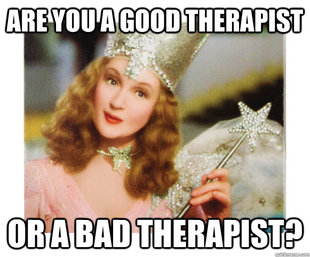
There's bad therapy, like those mentioned by ClinkShrink and by Dr. Breger, where the therapist has their own belief system and thrusts it upon the patient, whether or not the patient feels the interpretations resonate. We've talked before about what makes a good therapist. Maybe we should talk about what makes a bad therapist?
I'll give you my list, please write in and add to it.
A bad therapist:
- Falls asleep during the sessions
- Forgets to show up for the sessions (repeatedly, we all have emergencies or calendar/technological failures).
- Does not return phone calls (or other communications) or is generally not responsive.
- Over-emphasizes money issues with patients who have traditionally paid.
- Makes interpretations that don't feel relevant to the patient and insists they are true even when this repeatedly upsets the patient.
- Takes non-urgent phone calls during sessions routinely.
- Is generally disrespectful of the patient (curses at him, eats pizza during the session, berates or belittles him).
- Is preoccupied and not attentive on a regular basis.
I want to say that there are always exceptions, and so these "bad therapist" ideas need to be general. If the therapist just found out his wife has cancer, he may be less sensitive than usual or preoccupied, it doesn't mean he's a bad shrink. And therapists have their own bills, and their own individual financial issues which may or may not permit them to be flexible or reduce fees, but some ways of talking about fees are more sensitive than others.
Finally, there is no perfect therapist: Someone who does everything wrong and has an awful reputation may be seen in a totally different light by a patient who feels very helped by his/her style, and the most wonderful of shrinks will still see patients who don't like them--- there's an element of chemistry that can't be ordered off the menu.
So tell me your list of bad shrinky things to do.
Minggu, 29 April 2012
Psychotherapy as a Model for Positive Relationships
One of our regular readers wrote in a comment that she's read how the psychotherapeutic relationship is supposed to model a healthy relationship for the patient. I hope I got this right, I can't seem to find the comment.
So I think I missed that lecture in residency. It seems to me that while psychotherapy is about having an honest, trusting relationship (and that is usually a good thing), it is very different from the relationships we have in our real lives.
Psychotherapy is about the patient's life. In some ways, it's a rather narcissistic endeavor (and I don't mean that in a pejorative way, but it just is). Mostly it goes one way, and aside from the patient asking "How are you?" and perhaps a polite exchange about the therapist's life if the relationship lends itself to that, the session focuses on the problems and concerns of one person, without the expectation that the patient listen patiently or provide support, kindness, insights, or interpretation to the other party.
Healthy real-life relationships are two-way streets. And real life people have issues, demands, and problems. The psychotherapist is a little bit actor, who doesn't generally volunteer his own distress, and who may certainly have his own very screwed up life!
Oh, but you want to say that the therapist, by listening attentively and being supportive is modeling good listening skills, empathy, and kindness. Ideally, that's true. But the therapist is modifying his reactions based on the fact that he's learned a particular style of listening, understands that being non-judgmental is part of the deal, and responds in a way that is therapeutic for the patient. So he doesn't argue about politics, doesn't get indignant if the patient makes a degrading remark about something the therapist values, and when he confronts the patient with behaviors or thought patterns that need to be changed, he does it from a place that is gentle, respectful, and he backs down if the patient gets upset and can't hear it. In other words, the therapist sometimes quashes his own emotions and reactions for the sake of the patient. Real life people in two-way relationships just aren't wired to be 'all about you' all of the time. While a friend may see that you are upset and let you go off ranting (and thank you to my friends who do this for me) and listen nicely and therapeutically for a bit, this is too much to ask from anyone all of the time in a long-term relationship. People disagree, they argue, they have their own opinions, and they show it when they get offended or angry. One should not expect the people in their lives to react as their therapists do, in measure ways. Nor should they hold themselves to that standard when engaged in a relationship with others. It's nice if you can do it for a little while for a friend/spouse/relative in distress who needs a comforting ear. But don't go home and try to be your shrink. It's hard and you won't have any friends.
Ideally, a psychotherapist is very responsive and reliable. There are exceptions (oh for the shrink with ADD, or who runs overtime with an emergency, or who is just a bit disorganized), but generally, the doctor shows up. Probably a good thing to expect in one's important relationships, but it doesn't always work out that way, and there is some motivation for the shrink in that this is "Work" (and many people who are irresponsible in their private lives do prioritize "work") and the shrink gets paid.
On the positive side, in real life intimate relationships, you get to be together for more than an hour, it doesn't cost you big bucks to talk, there's some possibility that you aren't being pushed to talk about things you'd rather not, a hug or a kiss or a reciprocal statement of love can be very wonderful things, as can a card or a gift (chocolate is often good) or an offer to go out for coffee or a drink or a walk, when you're feeling distressed.
Therapists generally don't throw plates against the wall when they get upset with a patient, so if you need that type of adaptive behavior and restraint to be modeled for you, then I agree, the therapeutic relationship does show some healthier ways of responding.
Tell me what you think? What have your patients said they've learned from you, and what have you learned from your therapist?
Senin, 23 April 2012
Endless Therapy...and some other stuff, too.
Yesterday's New York Times appears to be dedicated to psychiatric bloggers. I got a head start with the article on SSRI's, but it's going to take me a while to catch up. Jesse-- can't I get you to post about Richard Friedman's article, "Why Are We Drugging Our Soldiers?" You're my military buddy!
So I'll start with "In Therapy Forever? Enough Already." Oh my. By Psychotherapist Jonathan Alpert who authored Be Fearless; Change Your Life in 28 Days. Excuse me, Mr. Alpert, but when is your next opening? I got me some issues that could use a quick fix.
Alpert writes:
He goes on to say:
Okay, so I'm all in favor of goals and structure and action plans. But a lot of people come for longer than 10 visits, they aren't all "failures" or stuck in a bad place (some, granted, are), and putting into words what happens in therapy and why it is helpful is really, really hard. The psychoanalysts invented their own language for what happens in therapy, and it's not one I was ever able to master.
Okay, so why would therapy take more then 10 appointments, in bullet points:
- Most people don't come to see me to fix a discrete problem. They usually come because they are uncomfortable with their feelings or behavior patterns --and screaming really loudly "STOP DRINKING" does not seem to work for me, maybe Jonathan Alpert has a better style. These problems, like depression or anxiety or irritability or mood lability or panic attacks or being really stressed out, come and go. The problems don't get 'fixed' with an action plan. They sometimes get fixed with medicines and therapy often provides some tools for better coping.
- Therapy offers a place to talk about feelings and behaviors that people are not comfortable talking to their friends about. Sometimes the issues are on-going and a single "dump" isn't enough. In these cases, therapy offers comfort. Insurance companies don't want to hear that: we need measurable goals that can be achieved in 3 sessions. Comforting those who are suffering is not allowed. (Please forgive my sarcasm)
- People usually can generate their own list of action plans and they come to treatment because fixing the problem is complicated and often they have stuff to work through before they can leave the lousy husband, or feel good enough about themselves to quit the job, or perhaps they shouldn't quit the lousy job because while they want to, it pays the bills and they can't find another job.
- Psychiatric problems wax and wane and people need more support when their symptoms are more intense, and less when all is well. It's not uncommon for people to come in more often during difficult times and less often during the good times.
- Some people have problems such that they drive people away and have trouble with intimacy. The therapeutic relationship may fill that void or be a place to examine those patterns. Sometimes people who don't have problems with intimacy still find the therapeutic relationship to be really useful.
- For people with behavioral issues, therapy provides a degree of accountability that can be very helpful.
So if you're a chronic patient and it feels useful, don't worry about it. You may not even be a failure. If you're frustrated that therapy isn't helping you to fix what you wanted fixed, go see someone else for a consult and second opinion.
Sabtu, 24 Maret 2012
Therapick: Match.com for Finding Psychotherapists
Here's their pitch:
Finding a therapist is a personal experience. On Therapick, you can search videos, read profiles, and email therapists you might want to work with. If you don't like the vibe of a psychologist, counselor, or healthy, move on to the next one. It's that simple. Our videos let you choose.
We've interviewed hundreds of licensed psychotherapists in Los Angeles, Chicago, New York, the Bay Area, and many other popular cities to give you the best selection for individual, couples, and family counseling in the United States. Whether you're looking for psychotherapy, marriage counseling, or even hypnosis, Therapick's videos give you a better sense of who a therapist is before going in for your first visit.
Minggu, 04 Maret 2012
T for Two and Two for T.
I don't do couples work. I didn't plan it that way, but very early in my career, I realized I'd had minimal training in couples therapy and people with marital problems deserved to be treated by someone who had experience in this area.
I do sometimes see my patients with their spouses, or even significant others, and it's always an interesting experience. I also hear from my patients that they will see their partner's therapist for couples therapy, and I'm never sure how that really works--- to me it seems that the allegiance, or agency, of the therapist needs to be clear. You're either working for the couple, or you're working for an individual. I don't know how you do both.
Since I only do individual work, it's very clear to me: I'm aiming for what's in the best interest of my patient. While I may like or respect or wish the best for their parent/child/spouse/or roommate, my goal is to help my patient. Sometimes it's a single goal: It's never in the best interest of my patient to do something that will cause physical harm to anyone-- if for no other reason than I think my patients are happier when they live in a setting where they get treated by me, and not by ClinkShrink (--meaning, not in jail or prison).
Sometimes I ask people to bring in a family member. Usually this is because either I need more information about the history, the current situation, or about what symptoms the patient may be exhibiting in their natural environment. More often, I ask people to bring in a family member because I need to enlist their help in either caring for a patient or monitoring them. Perhaps someone wants to go off a medication and past attempts have been unsuccessful-- it may be helpful to educate a family member as to what the symptoms of a recurrence are and an extra set of eyes may help catch problems earlier than I would be able to alone. Perhaps a patient needs more help in negotiating the day-to-day issues in life, like getting to a doctor to evaluate that mass, or to evaluate a memory problem.
More often, people ask me if they can bring their spouse, and it's not my idea. I often ask what the agenda is to be, why they want their person to come. Here are some reasons why people bring others to therapy sessions:
--They want me to fix the other person. (I can't do this).
--They want to confront the other person about a problem in a place where they feel safe (Can I go home now?...This is never fun).
--They just want me to meet the person they talk about a lot. (I often like meeting them and having a face and live person to put to the stories).
--They want me to explain what's wrong with them to someone who cares but doesn't seem to understand (I'm happy to try).
In a clinic setting where I see people for medication management, it's not unusual for people to bring family members into every session. The patient may not be someone who talks about their emotions or feelings, or even has any interest or ability to relay to me stories from their lives. Perhaps they have a brain disorder (like mental retardation or a history of a disabling stroke) and the medications are targeting disruptive behaviors or psychosis, and the person who comes is often the one to identify whether things are going well or not, in conjunction with the patient.
What are your thoughts on bringing significant others to sessions with a healthy?
Minggu, 18 Desember 2011
Missed Opportunities?
____________________________
When we talk about psychotherapy, one aspect of what we look at is the process of what occurs in the therapeutic relationship. This is an important part of psychodynamic-based psychotherapy, meaning psychotherapy that is derived from the theories put forth by Freud. Psychoanalysis (the purest form of psychodynamic psychotherapy) includes an emphasis on events that occurred during childhood, and a focus on understanding what goes on in the relationship between the therapist and the patient, including the transference and counter-transference.
In some of our posts, our friend Jesse has commented about how it's important to understand what transpires in the mind of the patient when certain things are said and done. Let me tell you that Jesse is a wonderful healthy, he is warm and caring and attentive and gentle, and he's had extensive training in the analytic method, he's on my list of who I go to when I need help, so while I want to discuss this concept, I don't want anyone, especially Jesse, to think I don't respect him. With that disclaimer.....
On my tongue-in-cheek post on What to Get Your healthy for the Holidays, Jesse wrote:
When I say the Shrink should look at the context, even in small matters a gift might come with a subtext: "I just told you some terrible things about me and I want to be sure you still like me." It can be a bribe. It can be a seduction. It can simply be a gift given out of gratitude. The important concept is that we think about everything. Unlike a physical examination done by an internist, everything that occurs might be some window into how we can help the patient, and we do not want to lose that opportunity.
So wait, the patient comes to me because he symptoms of a mental disorder, often depression or anxiety, or problems controlling his behavior, or he's overwhelmed with stress and isn't coping well. Why is it so important that we understand every aspect of the sub-texted interactions? How does this cure mental illness? Why is it bad to accept (or not) a gift and move on? Why do we have to think about everything? And if it's really important, won't it come up again? Is it really crucial that we not lose that opportunity? Maybe I just want to take the cookies and say 'thank you' because
- A) I don't want to hurt my patient's feelings,
- B) it can be difficult to look at the meaning without upsetting the patient or putting the patient on the defensive and so the patient has to be fully on-board for this type of therapy and those patients generally don't bring gifts (ah, maybe we should be asking all analytic patients why they didn't bring gifts, now that might yield interesting information), and
- C) I like cookies.
Just so everyone knows that I am still Jesse's friend, I am posting the video he sent me of his late grand-chinchilla, Chinstrap. And yes, Jesse had a grand-chinchilla. He does assure me that Chinstrap was having a good time in this video, because I wondered.
And I'd like to thank Steve over at Thought Broadcast for providing the graphic for today's post.
Rabu, 09 November 2011
All About Me!
Psychotherapy is, by it's nature, a narcissistic endeavor. That's not to say that the patient is a narcissist, but the journey itself is meant to focus on patient's interior life, and it's not always about the greater good. In my last post, several commenters said they feel uncomfortable talking about themselves or worry that their therapist will mistakenly think they are narcissistic because they that talk about themselves in therapy.
It's not at all unusual for people to express some discomfort about talking about themselves in therapy, or to comment, "all I do in here is complain," or "You must get tired of hearing people complain/talk about their problems, etc...."
I won't talk for other psychotherapists because I only know how I feel. It seems to me that the mandate of therapy is for the patient to talk about the things they have been thinking about. The truth is that most people think about themselves and issues of the world are interpreted by individuals as they impact them. Some people have lives that are very much focused around their immediate circle of events, the pain of their emotions, the distress of interactions with family, neighbors, friends, and co-workers. Others may spend time discussing how the people around them are behaving in unproductive ways, and some people focus on their concerns about broader political issues that are important to them. Most people don't come to spend their entire psychotherapy sessions discussing world events, problems in developing nations, the European economy, climactic issues in other parts of the country, or other world events unless these things directly impact them, or they are things they are spending a lot of time thinking about.
I like hearing about people's problems. I may empathize or sympathize or say things I hope will provide some sense of support, or perhaps offe an interpretation that will give the issue a broader meaning in the context of the patient's life, but I don't generally feel burdened by other people's problem. I am too busy feeling burdened by my own problems, and for the sake of my job, I get the luxury of being able to turn off my own problems and focus on someone else's internal world for 50 minutes out of the hour. I like this and I get paid for it.
Do I ever think a patient is narcissistic? Well sure, if they tell story after story where they seem completely unable to see that another person might have a different point of view, or repeatedly recount events where they've behaved with complete disregard for the feelings of others or respect for the law. For most of the people, most of the time, I think they're just people who come to therapy and they talk about themselves because that's what therapy is about. Am I bored? No. Do I ever wish a session would end and I could finish the day and go home and change out of work clothes and chill out and think about my own stuff? Yes, but that doesn't mean I find my patients boring, or that I don't care about them, or that I don't like listening , or that I don't like them. I think it means that sometimes I'm human.
Mostly, I listen and try to be helpful. I don't spend a lot of time judging. (I can't say never because I'm a human being and human beings sometimes judge each other and you may think a healthy should never do that but do write me when you've examined the content's of someone's heart and you've found the perfect non-judgmental person; I would like to have coffee with them.)
If you're worried that you're healthy thinks you're too self-involved because you talk about yourself in therapy, you might want to find something else to worry about. ;- ) (Roy will be back soon to translate my emoticons).
And just a quick fyi: the definition of narcissism per wikipedia:
Narcissism is a term with a wide range of meanings, depending on whether it is used to describe a central concept of psychoanalytic theory, a mental illness, a social or cultural problem, or simply a personality trait. Except in the sense of primary narcissism or healthy self-love, "narcissism" usually is used to describe some kind of problem in a person or group's relationships with self and others. In everyday speech, "narcissism" often means inflated self-importance, egotism, vanity, conceit, or simple selfishness. Applied to a social group, it is sometimes used to denote elitism or an indifference to the plight of others. In psychology, the term is used to describe both normal self-love and unhealthy self-absorption due to a disturbance in the sense of self.
Senin, 07 November 2011
Is it Ever Okay to Lie?
We've been having a great discussion over on the post Tell Me.... An Ethical Dilemma. The post talks about a young man who wants to know if he can check "no" to a question about whether he has a psychiatric disorder if his illness is not relevant to the situation. The comments have been fascinating -- do read them-- and very thought-provoking.
One reader asked, " If a patient asked if they were boring you, and they were, would you say yes?"
This is a great question, and of course the right thing to do is to explore with the patient what meaning the concern has to him. But is that all? I'm not very good at doing the old psychoanalyst thing of deflecting all questions, and mostly I do answer questions when they are asked of me. This can present a really sticky situation because one can not think of any clinical scenario in which it would be therapeutic to have a therapist tell a patient, 'Yes, you're boring, OMG are you boring,' or 'No, in fact, I don't like you.' And not answering could be viewed as negative response by the patient --if you liked me, you'd tell me, so clearly you don't like me. So if the exploration of the question doesn't take care of the issue, and the patient continues to ask, what's a shrink to do?
I'm not in favor of lying to patients, therapy is about having an honest relationship, but our readers have given some great examples. If a gunman asks for your money, is it okay to lie and say you have none? Is it okay to lie about whether you've been the victim of sexual abuse on a job application (one reader saw this!). Just because someone asks, do you need to answer truthfully? Of course, you can be truthful and say you don't plan to answer that question, but so many times, the assumption is that the answer must be Yes because if not, you'd have nothing to hide.
healthys don't owe it to their patients to be totally transparent. Shrinks have the right to their privacy, and professional boundaries dictate that it's wrong to share your problems with your patients (even if they ask).
That being said, it still can feel very uncomfortable on the shrink side of a couch when a boring patient asks if they are boring. What would you say?
Senin, 10 Oktober 2011
Guest Blogger Dr. Jesse Hellman: What are the Limits of Psychiatry?
Recently a colleague and I were talking about a question that had been posted on our psychiatric society's Listserv. The question had to do with the age at which a parent would tell their child he had been adopted, and who the birth parents were. This question is quite complex, depending on a multitude of factors. Child healthys responded, as did adult healthys. Is this a question, though, for Psychiatry? One might argue that the question has nothing to do with mental illness. But does our field define itself only as addressing mental illness?
A few days ago in the NY Times there was an OP-ED piece in which the author touted brain studies as showing that we do not just "like our iPhones" but "love our iPhones." When I read it I was surprised, as the idea of whether one might "love" an iPhone (or, for me, my camera or sports car) never occurred to me: Of course I do. What was surprising was the apparent sense of discovery by the author of a phenomenon that Freud had clearly described well over eighty years ago. He invented the word "cathected" to describe that we can "cathect" or imbue any particular thing, or even idea, with erotic energy and so love it with the intensity we have for living things. He explained that that cathected energy can be withdrawn from these things as well as from people, and the formerly loved object discarded instantly.
So psychiatry, to me, includes psychology in its broadest sense as well as the complexities of human interaction. In my own practice the most difficult and important issues are not usually the questions of medication but those that have to deal with all the issues that beset the patient that are then brought up in their sessions: getting promoted at work, the problems of a marriage, the competitive strivings within a family or its workday substitutes, the losses one faces inevitably in life, and so on. Almost infinite variety.
So how do others address this question? Just what is Psychiatry?
Selasa, 12 Juli 2011
Psychotherapy and Psychiatry: Keeping it Alive

On Shrink Rap Today over on the Psychology Today website, I talk about how high-volume, rapid-care psychiatry shows us at our absolute worst, and I report on survey results about how healthys in Maryland are practicing--- please be forewarned, this was from an emailed poll and the data was not validated or verified, but it is interesting!
On Shrink Rap News over on the Clinical Psychiatry News website, I make a case for why psychiatry residents should be required to learn how to do psychotherapy even if they don't plan to practice it when they finish training. We really don't even have a precise definition of what "psychotherapy" is, and CPT coding has defined it in terms of time spent in a session and reimbursements. A 50-minute session gets coded as 90807 which stands for "45-50 minute psychotherapy session with medication management on an outpatient basis in a physician's office." The frequency doesn't matter, nor does the content of what transpires-- at least not for the CPT codes. But certainly, not everyone who comes for a 50 minute sessions is actually in a formal insight-oriented psychotherapy. Good care involves listening to the patient before making decisions about medications, and seeing 4 patients an hour, lined up on a conveyor belt, hour after hour, regardless of the patient's need to talk or the complexity of the case-- is no way practice psychiatry (and I personally wouldn't have the stamina). Those who do it have bought in to an insurer's idea of how the world should work. In fact, very few healthys in Maryland reported that they practice this way, even if the media would have you believe that this is the norm in psychiatry.
I like to think of psychotherapy as a process over time where the talking itself is part of what heals. Certainly there is something about talking openly about things which may be troubling, embarrassing, or leave one feeling vulnerable, which is helpful, particularly in a setting deemed to be safe and free from negative judgment. From the healthy's point of view, psychotherapy is about looking for patterns in thoughts, feelings, behaviors, or reactions, and bringing these patterns to the patient's awareness in a way that may allow him to change.
Obviously, I think psychotherapy is important to psychiatry.
Please do check out the other posts on Shrink Rap News and Shrink Rap Today.
You are invited to comment on any, or all, of the websites.
While you're here, please take our sidebar poll ----->
And please do let us know if you have an active psychiatry blog or know of any for our list.
Thank you for participating in today's 3-ring psychotherapy post!
Minggu, 26 Juni 2011
Understanding the Research on Psychotherapy Trends-- a Discussion with Dr. Ramin Mojtabai
For whatever reason, it bothers me when media says that healthys don't do psychotherapy, and lately, it happens a lot. What am I, chopped liver?
They quote a study by Mojtabai and Olfson in the Archives of General Psychiatry, and say, "Only 10.8% of healthys see all of their patients for psychotherapy." Is that really true? Is it really relevant? I tried to read the article and I wanted to understand how the study was done so I could think about it myself, but I didn't understand how the research was done-- Roy thought it was based on CPT codes, then he said it wasn't. So why not go to the source? I asked Dr. Mojtabai if he would have lunch with me and tell me how the study was conducted.
If that got you curious, please read about it on over on Shrink Rap News! You're welcome to comment there if you're physician, or to surf back here and tell us what you think. Ramin says he's interested in what people think, and he's been very kind about humoring me, both over lunch and in the many subsequent emails over the details.
Kamis, 14 April 2011
PT: Psychotherapy "Alive and Talking"
I'm glad that Ron pointed out (as we have) that the 2008 Mojtabai and Olfson article -- which implied that only 11% of US outpatient healthys provide psychotherapy -- was a misleading statistic. Why? Because they did not consider brief psychotherapy sessions (30 minutes or less) to be classified as "psychotherapy" for their session. Thus, a 90807 (45-50 min) is considered psychotherapy, but a 90805 (20-30 min) would not be considered so, even though the AMA's CPT manual defines it as psychotherapy. Also, brief and supportive forms of psychotherapy are often given even when only a "med check" is billed. Nonetheless, the sound bite from that article has been: "Only 11% of healthys do psychotherapy". It just ain't true. As Mark Twain said, "There are three kinds of lies: lies, damned lies and statistics."
Sabtu, 09 April 2011
Psychiatry and Psychotherapy: We're still talking about it.
Over on PsychCentral, Dr. Ron Pies asks if psychiatry has really abandoned psychotherapy. He doesn't think so. Ron's post was inspired by Gardiner Harris' March 6th article in the New York Times that has had every psych-blogger buzzing and has made for countless undocumented shrinky conversations. Here at Shrink Rap, we didn't miss a beat.
Dr. Pies writes:
Let’s also acknowledge that the general trend reported by the Times — the diminishing use of psychotherapy by healthys — is quite real. Over the past decade or so, the percentage of healthys offering psychotherapy to all or most of their patients appears to have dropped. One study — very selectively cited in the Times article — found that “just 11 percent of healthys provide talk therapy to all patients…”1 This was based on a study by Mojtabai and Olfson,3 which found a decline in the number of healthys who provided psychotherapy to all of their patients — from 19.1% in 1996-1997 to 10.8% in 2004-2005. The study also found that the percentage of visits involving psychotherapy declined from 44.4% in 1996-1997 to 28.9% in 2004-2005, which “…coincided with changes in reimbursement, increases in managed care, and growth in the prescription of medications.”2
But the very same study found that almost 60% of healthys were providing psychotherapy to at least some of their patients. Also, the threshold for considering a session “psychotherapy” was set quite high in the Mojtabai-Olfson study: the meeting had to last 30 minutes or longer. But as my colleague Paul Summergrad MD has pointed out, common practice and standard CPT billing codes (e.g., 90805) specifically include 20-30 minute visits for psychotherapy, with or without pharmacotherapy.4 Furthermore, Mojtabai and Olfson acknowledged that
“Some visits likely involved use of psychotherapeutic techniques but were not classified as psychotherapy in the current analysis. Psychotherapeutic techniques can be effectively taught and used in brief medication management visits by healthys and other health care providers.”3 (p.968)
This last point was totally lost in the New York Times report. When I used to see patients for “medication checks” in my private practice, I would sometimes spend more time providing supportive psychotherapy than dealing with the medication issues, if the patient’s emotional needs warranted it. (If the patient was seeing another therapist in formal psychotherapy, I would try to remain an empathic listener, while encouraging the patient to raise the issue with the therapist). Furthermore, in providing medication for some severely personality-disordered patients, it is often impossible to maintain the therapeutic alliance without understanding the patient’s self-sabotaging defenses. As Glen Gabbard MD has observed, “…psychotherapeutic skills are needed in every context in psychiatry” — including during the much-maligned 15-20 minute “med check.”5
The cartoon is from the Wall Street Journal, sent to me by Moviedoc.