Tampilkan postingan dengan label empathy. Tampilkan semua postingan

Senin, 09 Juli 2012

Psychotherapy: the Down Side


In my review of Lou Breger's book Psychotherapy: Lives Intersecting, several readers commented that they felt injured by psychotherapy.  It's a favorite topic of ClinkShrink who wrote the section for our Shrink Rap about how therapy can be harmful, and likes to note that any treatment with the potential to heal also has the potential to harm. 


So I got to thinking Why Would Psychotherapy be harmful?
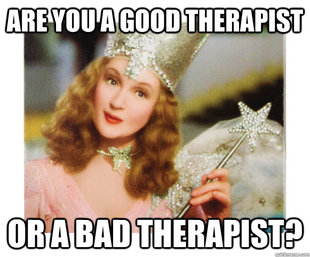
There's bad therapy, like those mentioned by ClinkShrink and by Dr. Breger, where the therapist has their own belief system and thrusts it upon the patient, whether or not the patient feels the interpretations resonate.  We've talked before about what makes a good therapist.  Maybe we should talk about what makes a bad therapist?
I'll give you my list, please write in and add to it.
A bad therapist:
  • Falls asleep during the sessions
  • Forgets to show up for the sessions (repeatedly, we all have emergencies or calendar/technological failures).
  • Does not return phone calls (or other communications) or is generally not responsive.
  • Over-emphasizes money issues with patients who have traditionally paid.
  • Makes interpretations that don't feel relevant to the patient and insists they are true even when this repeatedly upsets the patient.
  • Takes non-urgent phone calls during sessions routinely.
  • Is generally disrespectful of the patient (curses at him, eats pizza during the session, berates or belittles him).
  • Is preoccupied and not attentive on a regular basis.
These were my thoughts off-the-top of my head, certainly not a comprehensive list, but this list is more inclusive and includes a list of more obvious red flags like licensing issues, the therapist initiating a physical relationship, revealing the identities of other patients, etc.  
 
 I want to say that there are always exceptions, and so these "bad therapist" ideas need to be general.  If the therapist just found out his wife has cancer, he may be less sensitive than usual or preoccupied, it doesn't mean he's a bad shrink.  And therapists have their own bills, and their own individual financial issues which may or may not permit them to be flexible or reduce fees, but some ways of talking about fees are more sensitive than others. 

 Finally, there is no perfect therapist: Someone who does everything wrong and has an awful reputation may be seen in a totally different light by a patient who feels very helped by his/her style, and the most wonderful of shrinks will still see patients who don't like them--- there's an element of chemistry that can't be ordered off the menu.


So tell me your list of bad shrinky things to do.


Selasa, 20 Desember 2011

Does Mental Illness Make People Better Leaders?


We've talked before about whether people with mental illnesses can be politicians (or pilots, or doctors).  Today, on Midday with Dan Rodricks on WYPR, healthy Nassir Ghaemi, author of A First-Rate Madness: Uncovering the Links Between Leadership and Mental Illness makes the case that in good times, we need sane and stable leaders, but that in difficult times, "insanity produces good results" and that in hard times those with mental illness are better leaders.  He talks about how mood disorders lead people to be more realistic, empathetic, resilient, and creative.  Want to hear more?  Click HERE to listen.


Kind of nice to hear a positive take on psychiatric disorders for a change.  Tell me what you think.

Selasa, 12 April 2011

When A Thick Skin Helps


I had to follow up on Dinah's post "What Makes A Good Therapist." (Note to Dinah: I put the punctuation inside the quotation mark. I'm getting better!)

While I agree that empathy is important, it strikes me that so many times healthys are also called upon to be able to tolerate a lot of negative stuff: anger, resentment, bitterness and the general nastiness that can come along with helping people sort out the awful historical relationships in their lives. Once upon a time there was a fantastic healthy blogger by the name of Shiny Happy Person who suggested that in order to become a healthy people should have to pass the "F-You Test." In other words, you have to be able to handle people screaming and cursing at you. Somebody is going to suggest that only happens with my patients because I treat criminals, but I know this happens with non-criminal patients too.

How do you balance empathy with a thick skin? It gets tricky. If you genuinely care about your patients and want them to get better then it would be nice if they weren't nasty to you in return. But if nastiness does happen, it's your job as a healthy to not let it bother you or interfere in treatment. This is particularly true in forensic work when patients can regularly place blame on others (or on you!) for what goes on in their lives. And when a correctional patient makes demands or threats in order to get something inappropriate from you, a thick skin must be replaced with Kevlar. For the patient's own good, you have to have the toughness to do the right thing to avoid harm. (Eg. "I know you'd really like to have some Elavil for sleep, but since you're over 40 and have coronary artery disease and hepatitis C and have attempted suicide by pill overdose twice and have no recent EKG or liver function test results in your record, I really can't give that to you.")

Prisoner advocates criticize correctional health care providers for being cold or unempathic, but I think they are misinterpreting a necessary and appropriate line that a good correctional clinician has to walk. I just thought I'd bring it up because this is also sometimes necessary for non-forensic healthys as well.

Selasa, 05 April 2011

What Makes A Good Therapist?

This is for Dr. D.

We were having lunch when Dr. D mentioned she wanted to write a book aimed at teaching residents how to do psychotherapy. It would start with a section on What Makes a Good Therapist? What does she thinks makes a good therapist? Real life experiences which impart an ability to empathize. Do we grow from our own difficulties? More specifically, do we grow in to better therapists? I asked another shrink this, and he said that people like to believe there is some meaning to their suffering, and perhaps it's nice to believe that if you've been stuck suffering, then it makes you a better therapist, but he wasn't so convinced it was true. Me? I don't know, maybe. Or maybe not. Personally, I'm fine with the idea of not suffering, at all, ever again, so long as I live.

In residency, I was taught that warmth and empathy are important to being a good therapist. Empathy would speak to Dr. D's theory. These are hard things to teach--- I don't know how you make someone feel what they don't feel and empathy is there or it isn't. I do think people can learn responses that get perceived as empathic, and that this is important. When a patient talks about sadness around an issue and the shrink does not feel empathy, it's still important to have a modulated response that acknowledges the patient's feelings-- this sounds terribly difficult....tell me more about how you are feeling...or kind, gentle, silence, but not, "Yeah, yeah, well I'm glad your old hag of a cousin died, she was never nice to you anyway."

So what do I think makes a good therapist? The ability to listen and hear what the patient is saying, even if the shrink doesn't agree. A non-judgmental stance, and this can be harder than it appears. It seems obvious, but it can be hard when a patient talks about hard-to-hear things, such as a pro-racism viewpoint, or disliking people of the doctor's religion or political party, or feeling happy that another person is person is suffering.

Non-dismissive is even better. No one wants to hear that their feelings are stupid or unjustified.

Kind. That's important.
Probing in a way that brings up new information and insights.

Mostly, I think therapy is about pointing out to people their patterns of behaving and responding in a way that is not so painful that the patient becomes defensive, and lets the patient choose to make changes in these patterns. Some patterns are harder to break than others, and the really entrenched one are often components of one's personality.

I'm not doing so well here. I Googled What Makes A Good Therapist, so you can check out these links:
http://www.therapist4me.com/what_makes_a_good_therapist.htm
http://www.therapists411.com/therapist-information/what-makes-a-good-therapist.html
http://askdrrobert.dr-robert.com/goodtherapist.html
http://www.goodtherapy.org/what-is-good-therapy.html

From here, I'll leave it to you. What makes a good therapist?

Senin, 28 Februari 2011

Like Looking in a Mirror


Sometimes, I treat people who have the same problems I have in my personal life. It's hard. Oh, it's really hard. If I'm really distraught about something and a patient calls seeking treatment with a similar life circumstance, I will sometimes turn them away and recommend another shrink. But I don't always screen so carefully on the phone, and often "I'd like to make an appointment," will simply get a time and date.

The feelings get really complicated here.

If I feel I've had a role in creating my circumstances, then I wonder as my patients seek my counsel, Who am I to be making any suggestions, much less giving advice? Why are you looking to me, I've screwed up the same situations. Oh, you say, Dr. Jeff said on KevinMD that healthy's Shouldn't Give Advice, but you know, some of us do, and even when we don't, our feelings are often relayed through the questions we ask or the comments we make or don't make, or perhaps by the expressions on our faces, even if we don't say "You
should do X." I told a friend once that I feel uneasy, guilty even, in these situations, and he replied, "How do you think I feel?" Did I mention he does family work and was in the midst of a stressful divorce? And I have yet to ask a colleague who also does family work how he managed during the years his own children wouldn't speak to him. Oy, life can be tough, for shrinks just like everyone else.

So perhaps I listen to someone talking about his most personal feelings about a situation, and you know, if I've been there before, perhaps it's good that I can empathize. If I'm in the middle of it, sometimes I listen and the patient's words seem so unreasonable, so unjustified, and yet I recognize them as being exactly my own--it's like having my own anxieties bounced off a wall only to ricochet straight back into my face.

Do I tell the patient that I've been in the same place before? Generally, no. Therapy is about his problems, not mine, and I think in these situations my empathy is clear. I say things that are more poignant and resonant than I might in circumstances where I feel removed. And patients never ask if I've been in the exact same place. On some of the harder things-- things that have no precise quick and easy answer-- I've taken to saying, "Not only don't I know what will fix this, I don't know anyone else who does have the answer." This I can say because I've done my own searching.

I hope I'm reassuring and comforting to people who find themselves in the same places I dwell. Certainly, tripping over a few stones on the path makes one walk a little more gingerly and judge a little less harshly those who walk more slowly. Mostly, though, I worry that I'm a little bit of a fraud just for being in the room.