Kamis, 10 Februari 2011

Podcast 56: It's All Your Mother's Fault


Oh, not really.
In this episode, we talk about parenting. Now why do we talk about parenting: this is a psychiatry podcast, did someone forget to tell us that?

We talked about parenting for a few reasons:

It started with the tie in between trying to understand how mentally ill people become violent and we mentioned the very poignant article that Susan Klebold wrote on Oprah.com called "I Will Never Know Why?" about her son's role in the Columbine shootings and the awful toll this has taken on her. Somewhere, as a society, we've decided that parents are responsible for how their children turn out, and parenting topics are frequently addressed by patients in psychotherapy. We hear from patients who feel wronged by their parents and from parents who worry about doing right by their children. Ah, if only we had crystal balls!

This led us to talk about Amy Chua, the Yale attorney who wrote
Battle Hymn of the Tiger Mom and whose article "Why Chinese Mothers are Superior" in the Wall Street Journal has gotten everyone talking about parenting styles of the East versus the West. Is this a good thing or does it contribute to student suicide?

We also mentioned Dr. Richard Friedman's article from the New York Times, "Accepting that Good Parents May Plant Bad Seeds" and Susan Reimer's article in the Baltimore Sun, "Blame Jared Loughner's Parents--It's the Easy Way Out."

Mostly we talk about the uncertainty of it all and mention issues related to good-enough parenting, lousy parents who get resilient kids, and good parents who get lousy kids.

Thank you for listening. P
lease do write a review on iTunes!


****************************


This podcast is available on iTunes or as an RSS feed orFeedburner feed. You can also listen to or download the .mp3or the MPEG-4 file from mythreeshrinks.com.
Thank you for listening


Send your questions and comments to: mythreeshrinksATgmailDOTcom

Rabu, 09 Februari 2011

Shock Value


Electroconvulsive therapy, or ECT, is considered to be a highly effective treatment for depression. The story goes that roughly 90% of patients respond. The down-side is that it requires general anesthesia with all it's attendant risks, and patients may suffer from headaches, and memory loss. The memory loss is often mild, but there are cases where it is profound and very, very troubling. As with any psychiatric treatment ---or so it seems-- there are those who say it saved them and those who say it destroyed them. Because the risks aren't minor, the procedure is expensive and often done on an inpatient unit, and people generally don't like the idea of having an IV line placed, being put under, then shocked through their brain until they seize, only to wake up groggy and perhaps disoriented with a head ached, it's often considered to be the treatment of last resort, when all else has failed. This makes the 90% response rate even more powerful.

I'm no expert on ECT. I haven't administered it since I was a resident and I don't work on inpatients where I see people before and after. I've rarely recommended it, and then I've been met with a resounding, "NO." My memory of it was that it worked, and that most people didn't complain of problems. One woman read a novel during her inpatient stay. I asked if she had trouble following the plot (ECT in the morning, novel reading in the afternoon) and she said no.

The FDA has been looking at the safety and efficacy of the machines used to perform ECT. It's a fairly complex story where the FDA advisory panel was considering whether to keep ECT machines categorized as "Class III" machines which would now require machine manufacturers to prove their efficacy and safety. A reclassification as Class II (and therefore lower risk) would not require this stringent proof.

On Medscape, Fran Lowry writes:

If the FDA decides to follow the advice of its Neurological Devices Committee, it means that the 2 companies that currently manufacture ECT machines would have 30 months to submit a premarket approval to show that the devices are safe and effective.

ECT has been in use since before the FDA enacted new, more stringent laws for device approval, and healthys fear that the logistics of conducting new trials will pose insurmountable problems for the manufacturers.

They also doubt whether data from any new trial would be sufficient to convince a subsequent advisory panel of the efficacy and safety of the devices, long considered by the APA to be life-saving.

"It hasn't been yanked from the market right now," said Sarah H. Lisanby, MD, head of psychiatry, Duke University, Durham, North Carolina, and chair of the APA Task Force to Revise the Practice of Electroconvulsive Therapy.

"But the continued availability of this life-saving treatment in the long term lies in the hands of the FDA right now. We're pleased it wasn't taken off the market instantly, but if new trials are going to be required, it's not clear who will fund them and whether they will in fact even be done. This is the concern," she told Medscape Medical News.

David Brown has an excellent article in the Washington Post-- see "FDA panel advises more testing of 'shock therapy' devices."

(As an unrelated aside, since Roy claims that "everyone" is my neighbor , I'll mention that David Brown is also my neighbor. )

In surfing, I found a strong anti-ECT sentiment on many blogs. There were also those who said it helped them, but theirs was a quieter rant. I particularly enjoyed Electroboy's rendition of his treatment for mania.

If you have thoughts or stories, by all means....

Thanks to Bob Roca for the heads up on the FDA hearings.

Minggu, 06 Februari 2011

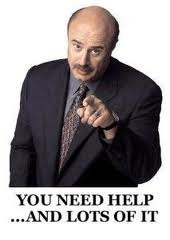
You Need Help!


Sometimes in my real life it becomes obvious that a friend or acquaintance is having a problem. Either they are wearing obvious signs of mental illness or they just show signs of being 'stuck' in life or, worse, of moving backwards. Often they don't see it. I suppose there is the outsider's vantage point of making a judgment that may reflect my own value system and not their reality: to me, I may see someone who has family and job and connections who sees leaving those things as a healthy escape and their withdrawal as a good kind of comfort with keeping their own company. Usually these aren't my close friends, but what do you do when you notice that someone in your life is changing and might possibly benefit from help?

In general, I've found that "You need help" is not helpful. People hear this as an insult, not as a kind suggestion from a concerned friend. And from a healthy friend it may be worse and easier to blow off---shrinks think everyone's crazy, they push drugs, they think everyone needs therapy, they see the world in a skewed way (at least this is how the commercial runs).

So I wondered: how do people let their friends know they need help in a way that inspires them to get it in the absence of a crisis? If you're in treatment because someone else suggested it, what enabled you to hear the suggestion without being wounded or insulted?

Jumat, 04 Februari 2011

What Do You Think Of This Video Ad?


From yesterday's mail:

I work with FINS.com, a career resource site owned by The Wall Street Journal. We are launching a new national ad campaign starting this week. We produced a series of videos about failed job interviews and what “not to do” tips. The fourth video in the series called “Strengths” (at http://www.fins.com/Job-Interview-Tips) and is set to begin airing early next week. A couple of us over here enjoy Shrink Rap. We thought that because the video is related to psychiatry, that it would be really cool to get your feedback and other reader’s feedback on the video prior to air date.

Thanks for your time in advance.

----So I watched the video and I thought, "Hey no one ever asks me to go their job interviews!" I watched a few of them: they are cute, and make a quick point, but you know, there is one with the tip Leave your Pets at Home. It shows a guy on an interview with a half dozen sweet dogs and cats, and I did wonder, "Well what about the support duck?" The Silence Your Cell Phone flick was so outrageous, but I don't doubt it happens at all. And Proof Your Resume....well maybe she should have gone with the flow when the interviewer was so impressed with her 'passion for finance' and not said she meant it to read 'passion for her fiance!'

So what do you think of the Strengths video? Are they poking fun of patients and shrinks, or is this something that has really happened and is it a valid tip? Yeah, it pokes fun, but so do all the others. Does it annoy you? Does it increase stigma? Is it cute with a reasonable point to make about how not to advertise one's weaknesses during a job interview?

Well those Wall Street Journal affiiliated folks want your input. Go for it!

Kamis, 03 Februari 2011

Just One More Question....


Thanks to Peter for bringing this article to my attention.

Have I ever mentioned that I hate forms? Oh, it's not just Medicare forms, it's all medical forms.
In private practice, there's not much paperwork. I see patients and I jot down a note for their charts. Sometimes I type a formal evaluation for their primary care doctor. Sometimes I need to fill out treatment plans or preauthorization forms for medications or forms for disability insurances. And these things are a pain in the neck, but most days there are no forms. I see patients, I turn off the phone, and I'm with them fully.

In the clinics where I've worked, the notes go on forms. There are simple questions to be filled out, nothing that exciting, but it pulls my attention. There's a line for the date. Oh, I do that anyway. Diagnosis. Usually I know that. Time I started. Oh, who cares? Usually I'm talking with the patient and realize I forgot that. I turn to look at the clock and record the time. First zap away from the patient. Age: ? I look at their birthdate. I subtract from the current date to get the year. Why do I have to calculate the age of every patient I see everytime I see them? There are computer labels on every page with the date of birth. If someone wants to know, why can't they do the math? Medical Diagnoses and Medications: I look that up. Date of last physical: ? I look that up or ask the patient. If it's been a while, I tell them to have a check up: Maybe that's useful, but every patient, every visit? I check the box that says they aren't suicidal and that I've discussed the risks and benefits of the medications and how often they come for therapy and what the goals are and if they are getting labs done. I update the medications on the log sheet and in the electronic record. I send a letter to their primary care doc listing their current psych meds: this is required even if their current doc is at the same hospital and can access the updated medications on the EPR. Time ended? I glance at the clock and record it. Duration of appointment: ....Oy, someone else can't subtract the minutes? I've taken to writing 17.3 minutes. Oh, and in there, there was lots of time to hear about the patient's life.

Okay, I'm ranting, but I felt vindicated when Peter sent us all Teresa Brown, R.N.'s article in the NYTimes Well Blog, "Caring for the Chart or for the Patient." Nurse Brown writes:

Because that’s my real concern: the effect on patients of incessant record-keeping. Each of these individual initiatives has merit and is worthwhile, but together they become a mishmash of confusing and oppressive paperwork.

Rabu, 02 Februari 2011

Super Bowl Psychiatry


Enough meditation. Let's move on to what people really talk about in psychotherapy: Football.

And no, I'm not kidding.

Here in Baltimore, the hype's died down as the fans remain catatonic. The purple lights have fadded and the only energy left is that which remains to cheer against the Steelers. Oh, something tells me that on Sunday, there will be lots of energy for Steeler hatred.

I don't really get it-- it's a bunch of too-big, way-too-old, guys in silly outfits chasing balls and charging at each other and they get paid millions to do this. I suppose it's an escapist thing, but I've learned never to say aloud that I don't get it, or worse, that it's just a game.

So SuperBowl Sunday, and the fans are psychiatric patients waiting to happen....the beer and the beer and the beer and maybe the fights will break out and they'll all end up on line to see ClinkShrink. Oh, and the angst and the panic, and the pre-game anxiety and the post-game euphoria/depression.

New York Times report Benedict Carey talks about treatment options in A Home Treatment Kit for Super Bowl Suffering. Mr. Carey suggests:

Breathing exercises are highly recommended and become increasingly important as the football contest nears the fourth quarter, when events on the field are likely to prompt strong physiological reactions, like a pounding heart, hyperventilation, even dizziness. These internal cues, as they’re called, can escalate the feeling of panic, a self-reinforcing cycle resulting in groans and cries that can be frightening to small children, pets and sometimes neighbors.

In the final minutes of the game, be forewarned: Many patients will move beyond the reach of therapy. Their faces may change, their breathing appear to stop. Researchers have not determined whether this state is closer to Buddhist meditation or to the experience of freefall from an airplane. All that is known is that, once in it, patients will fall back on primal coping methods, behaviors learned in childhood within the cultural context of their family.

Like emitting screams. Or leaping in an animated way, as if the floor were on fire. Or falling on their back and moving their arms and legs like an overturned beetle, in celebratory fashion.

This post is dedicated to my husband and son.

Selasa, 01 Februari 2011

Three Shrink Rappers Meditating on a Mountain Top....


On my post on meditation, Guzman from Montevideo, Uruguay left us a joke. I mentioned in that post that my mother took me to learn Transcendental Meditation when I was 10. Odd coincidence, but my mother also worked at the US embassy in Montevideo, long ago. Did you know her Guzman? It was many decades ago.

So I took Guzman's joke and I modified it to suit us three Shrink Rappers because it kind of suited our personalities:
Guzmán. said...

Jiddu Krishnamurti telling a joke...

“There are three shrink rapping monks, who had been sitting in deep meditation for many years amidst the Himalayan snow peaks, never speaking a word, in utter silence. One morning, Roy one of the three suddenly speaks up and says, ‘What a lovely morning this is.’ And he falls silent again. Five years of silence pass, when all at once a bird flies over and pulls the duct tape off monk Dinah's mouth and she speaks up and says, ‘But we could do with some rain.’ There is silence among them for another five years, when suddenly ClinkShrink, the third monk says, ‘Why can’t you two stop chattering?”


http://www.katinkahesselink.net/kr/jokes.html
http://seaunaluzparaustedmismo.blogspot.com/