Tampilkan postingan dengan label ducks. Tampilkan semua postingan

Senin, 02 Januari 2012

Ducking Around

Ooooh, let me tell you: I love vacation.  I really love vacation.  I'm back.  It's cold here, and I spent the day unpacking and doing laundry, and getting ready to start my week.  I returned calls, went in to the office and checked my mail, emailed, postal mailed, and watched the Ducks win the Rose Bowl.  Sad, because even though we Shrink Rappers like ducks, I have my own personal Badger out in Pasadena cheering for Wisconsin, and it's a sad football day for him, I'm sure. 


Roy did a great job of holding down the blog.  Please give him a hand.  Clink was off on another one of her adventures.  For some reason, vacation is not fun for her if there isn't the possibility that she'll fall thousands of feet, get eaten by some form of wildlife, or have her life depend on properly functioning equipment while she gurgles beneath the sea.  She's the only person I know where "I had a fantastic time" is followed by an injury report.


Roy's Happy New Year duck was taken from the Havre de Grace annual New Year's Duck Drop.  From the Aegis:
It was a glorious night for ringing in a new year. Temperatures, unusually inviting for a New Year's Eve in Harford County, hovered around 43. Wind was non-existent. And many people had gathered around the Havre de Grace Middle School grounds for the annual Duck Drop and fireworks to welcome another new year.

In other stories around the web, if you're a distracted duck, you might have notice that it's hard to find Ritalin or Adderall-- perhaps another example of DEA limits allowing Big Pharma to be being overly ducky about reducing supply of the cheaper, generic medications.  From the The New York Times, do check out "A.D.H.D. Drug Shortage Has Patients Scrambling."  


And if you're a duck contemplating filing for Social Security Disability, do read Dr. Steve's post on Thought Broadcast about The Curious Psychology of "Disability."  With 41 comments on that post, I'm going to swim away from the temptation to comment myself. 

And finally, for those ducks who want to know the latest on Electronic Medical Records, check out Shrink Rap News over on CPN for "Notes from SAMHSA's EHR Summit."  If that doesn't make you want to be served up with orange sauce, then nothing will.

So I love vacation, but I did miss all the Shrink Rappin.'  Happy New Year to everyone!  


From Clink: I don't have a duck in this race, so I thought folks might enjoy a seahorse instead. He's black with white stripes and seems to be perched on top of the green moray eel's head. Yes, the eel was that close.

No significant injuries this time.  A slight jellyfish sting and lots of no-see-'ums, that's it.

Minggu, 13 November 2011

The History of The Duck, etc....


Those of you who are regular Shrink Rap readers know we are rather attached to the image of the yellow rubber duck.  It started with an article on Emotional Support Animals that was in the New York Times right after we started our blog, and we latched on to the imagine of airline passengers who brought ducks (one dressed in clothing) on to flights, and then Clink began her years-long hobby of animating ducks!  And of course there was the lovely reader, DrivingMissMolly, who donated a flock of ducks to Heifer International in our behalf.  The duck appears on our blog, it was the subject of heated debate and designated committee meetings when our book was in press (see They Nixed the Duck!) and it's on our logo in the print version of our column on Clinical Psychiatry New.  We distribute candy ducks at all Shrink Rap public events. 


Needless to say, I was quite pleased to see an article in this morning's New York Times Magazine on the history of rubber ducks.  In "The Rubber Duck Knows No Frontiers,'  Hilary Greenbaum and Dana Rubinstein write:

This yellow, doe-eyed icon — a preferred bathtub ornament of toddlers and royals alike — would have never existed were it not for Charles Goodyear. The Massachusetts inventor discovered the chemical process that renders rubber more malleable (and thus appropriate for toys) by, as legend has it, inadvertently dropping a mixture of rubber and sulfur into a potbelly stove. Goodyear, who died in 1860, never benefited from this discovery, but his vulcanization process revolutionized the rubber trade.

Greenbaum and Rubinstein go on to note:


Still, it was only when Ernie, of Bert and Ernie fame, took a bubble bath with a rubber duckie in 1969 that the toy became inescapable. According to Tim Carter, a senior producer at “Sesame Street,” the story goes like this: Someone gave a rubber duckie to a “Sesame Street” writer named Jeff Moss, who put it in his bathroom window. One night while taking a bath, Moss looked over and had an epiphany. And “Rubber Duckie” subsequently reached No. 16 on the Billboard chart. “It wasn’t until ‘Sesame Street,’ ” says Charlotte Lee, a Seattle-based engineering professor who holds the Guinness World Record for the largest collection of rubber duckies, “that a rubber duck became a special thing.”  

For those who would like a psychodynamic interpretation of Ernie's relationship with his duckie, Shrink Rap provides one Here. 
--------------------
In other Shrink Rap events:
  • Clink has an article up on Shrink Rap News on how social media does a lousy job of representing Forensic Psychiatry.  Please do read What Follows Is Fiction: What Orson Welles Can Teach Us About Social Media.   
  • We enjoyed our book signing at Baltimore's Ivy Book Shop on Friday evening and met some great people.  We posted a photo of ourselves with author Gilbert Sandler-- he says he needs all the help he get.  He's a charming man!  Do visit our Facebook page at http://www.facebook.com/shrinkrapbook to see event photos, and do click the link to "follow" us on Facebook for the latest Shrink Rap updates.
  • We are podcasting later today, we should have new episodes of My Three Shrinks up in the coming weeks.
  • Jesse tells me he's planning to submit a guest post about factors that keep people from reporting heinous crimes, so do check back later today.  The events at Penn State seem to have everyone stirred up.


Senin, 30 Mei 2011

Right About Now, We Need A Duck Break


I showed up at my community's organic vegetable garden to work yesterday morning. I was a little late and people had begun to disperse. A neighbor tossed some spinach my way. Another said, "Larry says we need ducks."

We need ducks? We have a patch of land by some athletic fields. No pond. Are we going to eat the ducks? No, they are going to eat the bugs off the vegetables. Interesting. I'd never heard of this. Larry's raised ducks before? Last week he was talking about chickens. It's all so confusing.
Apparently Larry wants us to research ducks, and so here is what I found:

http://www.grit.com/Livestock/Raising-Ducks-Helps-Your-Garden-Patch.aspx

The photo above, by the way is a picture of ClinkShrink and I together in Hawaii. I'm the duckier duck.

Minggu, 15 Mei 2011

We Got Our Duck!


Jackie, our wonder editor, told me there was a duck surprise. Oh, good. I like surprises. And Shrink Rap likes ducks. And then I forgot.

So this morning I went to check out the Johns Hopkins University Press booth at the Exhibit Hall here in Honolulu at the APA. Lots of books, lots of people, and they have a poster up for Shrink Rap in a corner. And a big screen with images that change. Then I noticed it: the Shrink Rap stuff all has ducks on it! This, after they denied us a duck on our cover and said it made us look like quacks.

Ok, so it's beautiful here in Oahu and I'm off to soak up some sun.
I woke up at 5:20 this morning and have been learning about psychiatry all day!

Just a quick note to myself and a to-blog-about list. We've been so busy lately that time has been short for blogging and podcasting, but I still have ideas, so coming posts will (some day!) be:

--Response to the med student who wanted to know how to deal with negativity when she says she wants to be a healthy.
--What is anti-psychiatry and why does it bother me. (Please pray for me if I go there).
--The chapter I wish I'd written, inspired by Jesse's comments.
--We got a request to talk about how autism may mimic psychiatric symptoms on our next podcast. Maybe we'll respond to the medical student on a podcast instead.

Ever feel like life gets just too busy? Okay, having fun at APA, gotta catch some rays now.
--

Sabtu, 02 April 2011

Which duck?

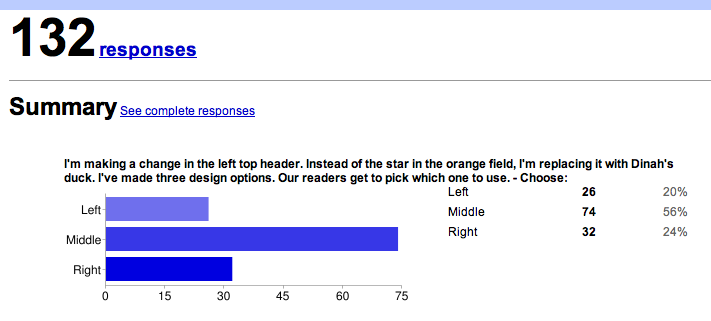
I'm making a change in the left top header [update: already changed]. Instead of the star in the orange field, I'm replacing it with Dinah's duck. I've made three design options. Our readers get to pick which one to use.


Update (4/5/2011): Thank you for everyone who voted over the weekend. The middle (yellow) duck won out. We received 132 votes; Google Forms does not provide any mechanism to prevent multiple votes from one IP address, so it is probably less than 132 individuals. Just sayin'.


Jumat, 11 Maret 2011

Roy is Driving Me Crazy!


I'm at my office today and I turn on my phone between patients. There's a text and a message, both from the same person. "Where is Roy, he's supposed to be here at a meeting? Can you contact him?"

Interesting. I scratch some body part or the other. Am I Roy's mother? Did someone forget to tell me? I forward the text to Roy, and welcome in the next patient. After that session, I check messages again. Roy has texted me, "I can't talk, I'm in a meeting." I guess he got there. Oh good.

And the blog. We have a rule about the sidebar: Dinah doesn't touch it. It's Roy's rule, but I've had a few problems, so mostly it's okay. But then, I decided I wanted a duck on the side bar. I put one up. That I can do. Roy took it down, because if I say Earth, Roy says Mars. Duck> No duck. No duck> Duck. Should I start reverting to reverse psychology? What was wrong with the duck? I liked it. Roy put up a link to our book's Facebook page---you remember, that book we've been writing for about a zillion decades that never actually materializes. I promise (I hope) that it isn't just a pipe dream. So the book's Facebook page has a whopping 8 fans and their photos are shown on our sidebar. Does Jesse the Chinchilla Lover want his photo on Shrink Rap? Do we want to advertise our 8 fans? I take it down. And Roy tells me he's frustrated that I undo things he does without talking to him first. But my duck-- he took down my duck! And he didn't talk to me first.

Why does Roy want the Facebook page up anyway? Does it matter? How will our Shrink Rap Book FB page change the world? Oh, we had tried a Shrink Rap friend page, but that was too hard to manage. I had to sign out of my own account and confirm new friends, and interact with them, and I'm a bit on overload (in case you couldn't tell!). We tried a "fan" page and that was fine. Only it was linked and combined with the
friend page and who knew what was what. I was pretty confused and I created them! So Roy made us a FB book page, only the book's not out, so he doesn't want anyone to know. But he does want 25 people to be fans so he can reserve a specific URL for it. HuH? And then he put his twitter feed in to it which would be good---Shrink Rap posts would populate the wall, but then he had a twitter conference and all sorts of random tweets went twitting away on the wall and in my News Feed. I think I'm way too old for this. Anyway, Roy is driving me crazy.

Please join our Shrink Rap Book page so Roy can drive you crazy, too.

And Clink has a new "old" post up on Shrink Rap Today over at Psychology Today.


Selasa, 15 Februari 2011

The Duck Was Nixed!


As our publisher was designing the cover for our book, we put in a request. We'd like a duck on the cover. No Duck, we were told. As we dusted ourselves off, our editor came back and said the design department had agreed to put a duck on the spine of the book. We rejoiced! Here and there, Roy would mutter about the duck. Remind them, don't let them forget about the duck. As the cover was finalized and the galleys were finished, we received a note from our beloved editor. Are you sure? Of course! P
eople will think you are quacks. But we're not quacks, anyone who reads our book will know that. Roy was convinced that it would add to the idea that this isn't just another dry reference textbook, it's an easy to read, ducky kind of book. I thought a little duck would be fine. Our editor sent the picture of "our duck:Now let me tell you.
I did not like this duck.
I did not like this duck at all.

The duck had long lashes, looked way too happy for a psychiatry book, and looked like a toddler's bath toy. We're shrink rappers, but we don't squeak! Oh, and we're not quacks.

Here is the duck I wanted. Very small, very subtle. Think of the penguin logo for Putnam Books.
Only think of it as a duck. Here is the duck I wanted. Our editor agreed, I think, that it was a better duck:


And happy with our duck (though ClinkShrink thought the first duck with the flirty eyelashes was fine)... I get an email from the marketing department. It is a very serious email about how well they think our book will do, and how packaging is important to the overall product. The upshot: there will be no duck. Our opinions were not wanted, the duck was gone, it was a done deal.

Quack?

Oh, the duck would have been just fine....

Sabtu, 01 Januari 2011

Happy New Year!


Happy New Year to all our readers. Can you believe it's 2011? I remember being a kid and thinking how long it would be until 2000 and thinking I'd never actually be that old.

I almost saw out the Old Year with Roy. We went out to a local pub for the best of Baltimore's crab cakes, and Clink didn't join us, but she did text in that there was a Duck in her Jacuzzi at what ever wonderful vacation spot she's in. A duck in the Jacuzzi and we didn't even get a picture? This from the woman who texts me photos of every mushroom she runs across? We parted around 10, and for the first time in years, I was awake at midnight, drinking champagne and eating chocolate by the fire with family and friends (non-Shrink Rappers)...who came over to see the year out with us.

Shrink Rap will turn five in April. This is our zillionth post (well, not quite, but we're somewhere over 1,300 posts). Our book will be coming out around the same time, if you'd like a preview, it's up on Amazon, but not yet available. We're scheduled to talk at APA in Honolulu this year, but our talk, The Public Face of Psychiatry, has been scheduled at 7 AM on the last day of the conference. Will anyone come? 7 AM???

Finally, this past week, we were mentioned on The Psychiatric Nurse Practitioner Blog as one of the Top 50 Psychiatry Blogs (I didn't know there were 50 Psychiatry Blogs!)-- do check it out-- and we had a guest post up on Kevin MD, a revised version of our post on How to Find a Shrink.

Jumat, 22 Oktober 2010

What I Learned: Part 2

Continued coverage of the American Academy of Psychiatry and Law (AAPL) conference. For Part 1, click here.

Day Two began with a section on PTSD as a criminal defense in military criminal cases. There was a presentation of a murder case committed by several military personnel in Iraq, followed by a discussion of the uniform code of military justice (UCMJ) rules of criminal procedure. The limitations of PTSD as a diagnosis was discussed, specifically the fact that many symptoms of PTSD overlap with other psychiatric diagnoses and that some people meet symptom criteria for PTSD without ever being exposed to a traumatic event. In 2008, 2.9 million veterans were receiving compensation for PTSD.

In criminal cases, defendants can claim self-defense if they have a reasonable belief that they are in imminent danger of serious bodily injury or death, if the force used in self-defense was reasonable, if the defendant was not the aggressor and if the defendant had no opportunity to retreat. Problems happen when the defendant reasonably believes he is in danger, but there is no objective evidence of imminence. (Eg. battered spouse syndrome and "burning bed" cases: a woman believes she is in danger and pre-meditates violence in self defense.) Soldiers with exposure to traumatic events may base a PTSD defense on a reasonable belief of danger, in the absence of imminence. Although the term "battered soldier syndrome" is not actually used in these military cases, they are clearly drawing an analogy.

As an aside, the UCMJ is interesting in that in courts martial, the military panel (analagous to a jury) decides guilt and also passes sentence. Judges have no role in sentencing. Also, there is no option for bail at the pretrial stage. Defendants have a right to a trial within 120 days, which is not much time to prepare a case for a felony offense.

In a presentation about zolpidem (Ambien) I learned that there were 22 criminal cases at the appellate level in which this medication was used as a defense. Ten were driving cases, seven were violent offenses. Zolpidem has been associated with sleep disordered behavior when combined with an SSRI. There have been 16 cases reports of zolpidem causing improvement in a chronic vegetative state.

There was a fascinating talk about tasers given by a guy from Utah. Apparently tasers have a USB data port that is used to gather stored information about when the taser was used and how many tasing cycles were triggered on a defendant. The presenter collected data from many police departments around the country regarding taser use and the nature of the defendant. He found out that in two-thirds of the cases the taser is never actually fired---merely pointing the taser at a defendant is enough to cause the defendant to surrender. When a taser is used, 82.2% of people required a single cycle. The majority of the cases in which a taser was used was on a defendant who was mentally ill and/or intoxicated. According to 1999 Justice Department data, only 2.1% of arrests actually require the use of a police weapon.

I went to the forensic sciences lecture, which is usually my favorite presentation. The American Academy of Forensic Sciences is a companion organization to AAPL and some of our members are shared between the two organizations. Anyway, this year's presentation was about computer crime. Sadly, it was bad. While the investigator was a good speaker, he didn't say much of anything about the techniques of how computer crime is actually investigated. There was no case presentation. The only crime discussed was online child pornography. The mental health professional talked about child porn users, but made at least three pretty outrageous anti-feminist statements. (Eg. women who made late accusations of child sexual abuse had been 'brainwashed by the feminist movement.') A female forensic healthy audibly blurted out "that's bullshit!" and I could hear the silent dropping of jaws. The most enjoyable part of this talk was when the computer investigator had trouble getting the audience survey system to work.

Lastly, I went to a talk about a survey given to 492 members of the South Carolina bar. 83% of the lawyers said they felt their law school training about mental health law was inadequate. Two-thirds had personal or close experience with mental illness. Judges were the least knowledgable about mental health law compared to public defenders, private attorneys and prosecutors.

Tidbits from the poster session:
  • 27 states have statutes with lifetime restrictions on gun ownership for people with mental illness. Other states have time limited restrictions on ownership, and some allow restoration of full rights contingent on a physician's documentation of recovery.
  • One poster studied inpatient threats in a state hospital over one year. Only one-quarter of the threats were deemed credible by the treatment team, and only one-half of these threats were thought to meet criteria to carry out a Tarasoff warning.
  • There was an interesting review of the Maurice Clemmons case in which public information was used to assess his risk of violence. I blogged about the case here, and provided links to the published clemency materials. Using two violence risk assessment instruments, the poster found Clemmons to be a high risk offender. Easy to say based on his history, but of course the limitation of static risk assessment instruments is that your base risk never lowers. You can get worse, but never better.
  • A national household survey of substance abuse, done annually with tens of thousands of people, showed that 3.8% off all women had used methamphetamine at least twice in the past year. Female meth users were more likely than users of other substances to be involved with the law, but not necessarily for violent offenses.
  • Two states automatically drop misdemeanor charges against incompetent defendants, as required by their statutes.
  • One study found no correlation between a history of childhood sexual abuse and being a perpetrator or victim of inpatient violence.
  • Prisoners over the age of 65 are twice as likely to have at least one chronic medical condition compared to an age-matched sample in free society.
  • Medical students from UCSD who rotate in a jail for their psychiatry experience consistently rate this rotation as their favorite. One quote from the medical student survey stated: "I love jail!"
Finally, my favorite poster: THE FORENSIC ASPECTS OF SERVICE ANIMALS!

YES!!! EMOTIONAL SUPPORT DUCKS HAVE COME TO AAPL!

This is the poster that won my heart. We've discussed this on the blog and we mention it in the book. Now, the "official" word. A poster entitled "Noah's Ark: A Forensic Review of Service Animals in Psychiatric Settings" provided an overview of ADA requirements for service animals in hospitals and clinics. In addition to guide dogs for the blind, other service animal cases involved monkeys, chimpanzees, miniature horses and parrots. Animals may be excluded from operating rooms but not any other general treatment setting. Potential for infection cannot be used to exclude animals, nor can mere concern about safety separate from an actual safety-related incident. Animals have to be able to meet minimal expectations for cleanliness, orderliness, nonaggression and "unnecessary vocalization". The sole determinant of whether an animal is a service animal versus a pet is the patient's declaration: a health care facility cannot demand documentation that an animal is certified or trained as a service animal. Finally, there have been cases of fraudulent service animals: people who put homemade "vests" on their animals and falsely identified them as a service animal. In California this is a crime punishable by six months of incarceration and a thousand dollar fine. I'm not sure how you'd get a vest on a fake service parrot.

So there you have it. I'm bringing my duck to the next session.

Kamis, 23 September 2010

What Do You Want To Know About Psychiatry?


When you work in any setting, your view of it becomes distorted. Your vision becomes tunneled, and the world looks small. My husband came home one day upset because a client had burst into tears while they were talking. "Why does that bother you?" I asked. Apparently it's not something that happens a few times a day for him. And when I was a medical student on an oncology ward, one of the doctors came in for rounds late---on her to way to work she'd seen a young man get knocked off his bicycle by a automobile. She'd stopped to help, and her first question to the young man was, "Are you a smoker?" She quickly realized that it was not a particularly relevant question in that setting.

So do people in the real world have questions about psychiatry? What are they? What a time to ask: just as our book goes for it's final draft. I should have asked before-- What do you want to know? Maybe we're wrong about what we thought people want to know. Maybe we need to write a second book.

The good news is that after several requests, the jacket designer has agreed to add a duck. Bless our editor for asking--- no clue how she explained that one.

Why do I feel like we've been working on this book forever? Clink will tell you, "because we have."

So what questions do you think the general public has about psychiatry? Go for it.