Minggu, 29 Juli 2012
Is Depression Inherited?
I don't usually do the Sunday morning New York Times thing, but Dinah is away and doesn't have a laptop so she asked one of us to put something up about this for her.
Today on the New York Times, a piece entitled "Is Depression Inherited?"
The story, by Daphne Merkin, is about her lifelong struggle with depression and the role it has played in her life as a mother.
She was first hospitalized when her daughter was six months old and at least twice more after that during her child's adolescence. She talks about the guilt she felt when her daughter once ran into her bedroom and threatened to kill herself with a knife at the age of six. She worries that her child will learn her previous maladaptive ways of coping and end up dealing with a depressive disorder dealt her by a quirk of genetics.
She discusses the heritability of depression---about 40 percent---but qualifies this with the unknown factors of unexpected traumatic events and factors related to resiliency, like having loving and consistent parents.
In the end, genetics are not destiny and just being aware of the risk may be enough to protect the children of depressed parents.
Kamis, 27 Januari 2011
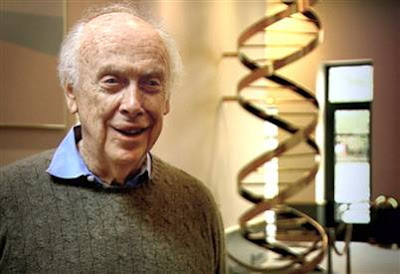
James Watson Live!
"To succeed in science, you have to avoid dumb people... Even as a child, I never liked to play tag with anyone who was bad as I was. If you win, it gives you no pleasure. And in the game of science-or life-the highest goal isn't simply to win, it's to win at something really difficult. Put another way, it's to go somewhere beyond your ability and come out on top."
-- James Watson, "Succeeding in Science: Some Rules of Thumb", Science, 261, 24 (September 1993): 1812. September 1993.
Snowy here in Maryland.
Yesterday, there was just a little snow, a three-inch surprise in the morning, and schools were closed, things were surprisingly still. My agenda included a trip to Hopkins to hear Nobel prize winner James Watson speak. Was it canceled? Did I really want to risk being caught in the snow coming home? No, it wasn't canceled. And when would I ever get the chance to hear James Watson speak? So yes, I did risk the weather, and it was fine.
I've never seen Hurd Hall so packed. No chandeliers, but people were hanging off the balcony, snow date and all. There weren't a lot of healthys there, even though the lecture was sponsored by the Department of Psychiatry, but this meant I got a front row seat in the reserved section.
Dr. Watson was an entertaining speaker, to say the least. He structured his talk around his "rules" for life, and said there were rules involved in the race to find the structure of DNA. Oh, I wish I written them down. He started something like this, "I was a boy on the South Side of Chicago and the first rule was Don't fight bigger boys or dogs." His second rule of life had something to do with putting a spin on balls. The rules around the story of the discovery of the double helix included things like don't be the smartest person in the room, don't research the same thing that everyone else is researching, leave a job before you get bored with it, speak to your competitors.... it was all told with a sense of humor and I should probably have taken notes for a few good quotes and a better taste of the rules themselves, but who knew? Oh, and I didn't have a pen. I have to do something about that.
Dr. Watson's account of the discovery of the structure of DNA is written in The Double Helix but since the publication of the book, letters have been found that shed more light on the relationships between the players, and Watson quoted some of these letters. They weren't quite what you'd expect from geniuses who were changing the course of science, and I suppose I forget that all stories have interpersonal dynamics and the associated banter as part of their plot.
You knew who Watson liked and who he didn't -- the stories weren't subtle, and oh, he said some things that were a bit off from the politically correct...it made for entertainment. Did he really say that? I won't repeat them, because we try to be a politically correct blog here, but you can get the flavor from the quote above.
Selasa, 18 Januari 2011
Genetic Friendships
Here's an interesting article I came across about the role of genetics in friendships. Two researchers studied genetics found in social networks. They asked people in two longitudinal studies to name their friends, then they compared certain genetic markers. They found that the DRD2 gene, which is associated with alcoholism, tends to cluster among friends. In other words, DRD2 positive people tend to be friends with other DRD2 people. Conversely, the CYP2A6 gene carriers tended to make friends with CYP2A6 negative people. This gene is associated with people who have open personality styles. In other words, a tendency to seek out variety and new ideas.
I'm not sure what to make of all this except to say I think it's interesting that there may be a biologically driven reason why Dinah and I are friends. In many ways we're the exact opposite. Dinah is a whirling dervish of multi-tasking in a way that I find exhausting, yet she seems to thrive on it. I'm an obsessionally detail-oriented and data-driven person who never loses her car keys (or drowns a cell phone). I enjoy living this way but have no doubt that Dinah would go mad from boredom within hours if we ever woke up and found our lives had been switched. I can guess which one of us has the CYP2A6 gene. The scientists would say that we are friends because we have complimentary genetics---traits that balance off and help one another. And I guess that's true. Our book might not ever have been finished if Dinah hadn't kept us moving and on task. And it wouldn't have been as organized and readable if I hadn't followed up with the editing. So it all works out in the end.
Now we just need to find a gene that protects against cell phone loss.